
Collections
Orphans arrive in ragged clothing. Etchmiadzin, c. 1917–1918.
Location
Etchmiadzin, Armenia
Year
c. 1917–1918
Item Detail
Etchmiadzin, seat of the Catholicos of the Armenian Church, lies a few miles outside Erivan below Mount Ararat. It had sheltered refugees since 1915, when 45,000 gathered there, and 3,500 children without parents crowded into its school.
In 1918, the orphanages around Erivan were run by the Armenian government and local committees. When the other American relief workers left that March, John Elder and James Arroll stayed on and kept American relief money reaching the district. The American Committee took over the orphanages in May 1919 and became Near East Relief that September. By then, its Etchmiadzin workshops employed some 2,400 refugees. When Turkish and Kurdish forces attacked Igdir that month, 856 orphans walked to Etchmiadzin.
Context
These photographs come from the American Unofficial Collection of World War I Photographs (165-WW) within Record Group 165, Records of the War Department General and Special Staffs, held by the U.S. National Archives. The United States government assembled the collection during and just after the First World War from many sources, among them the publicity work of the American Committee for Relief in the Near East (ACRNE), the relief organization that Congress incorporated as Near East Relief in 1919. The Near East images date from 1918 and 1919, as American relief in the region moved from wartime emergency to organized operation.
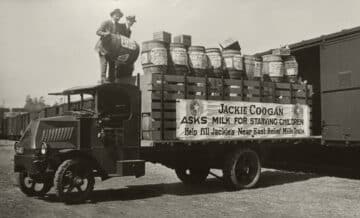
The selection documents two sides of that effort. In the field, it records relief stations, hospitals, and orphan care among Armenian, Assyrian, and Greek survivors of genocide and displacement across the Caucasus, eastern Anatolia, and northwest Persia. At home, it records the American mobilization that paid for the work: fundraising drives, relief ships loading at New York and Hoboken, and the volunteers who sailed to distribute food and supplies.
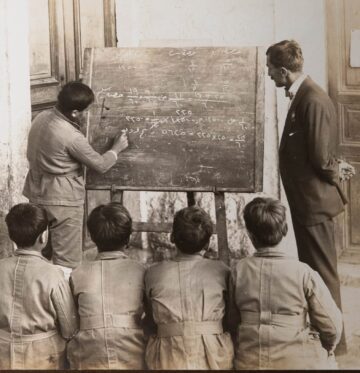
In the Caucasus, American relief concentrated on the Armenian survivors who had fled massacre and deportation in the Ottoman provinces and gathered around Erivan (Yerevan), Etchmiadzin, and Alexandropol (Gyumri). These photographs record the working machinery of that relief: the Hospital of Brotherly Help and the crowded court at Etchmiadzin, food and quilt distribution at Erivan, the wool department that put refugees to work, and the orphans and starving children who were the campaign's central concern. The images date from 1918–1919, as relief shifted from emergency feeding toward the orphanage system Near East Relief would run through the 1920s.
-
Holding Institution
US National Archives and Records Administration
-
External Link
-
Attribution
American Unofficial Collection of World War I Photographs (165-WW), Records of the War Department General and Special Staffs (Record Group 165), U.S. National Archives and Records Administration
-
Rights
Public domain (U.S. federal records)
-
Notes
Original caption: "Orphans reaching Etchmiadzin, half naked and in rags."
National Archives: NAID 45560207, local ID 165-WW-559C-34, file unit "War Relief – American Committee for Armenian and Syrian Relief," American Unofficial Collection of World War I Photographs (series compiled 1917–1918). The record gives no item date.
Visual note: two men wear Russian Imperial–style tunics and peaked caps without visible shoulder boards; other adults are in civilian dress, several with rosettes or badges. No American relief uniforms appear. No one is identified.
Sources: James L. Barton, Story of Near East Relief (1930), pp. 80–88 (Catholicos at Echmiadzin; cables of August 1915; Tiflis committee; March 1918 evacuation; Elder and Arroll). Edward Perry, letters from the Caucasus, 1919: 17 April (Elder ran Erivan district relief; orphanages taken over 1 May); 8 September (ACRNE became Near East Relief, 1 September); 17 September (Etchmiadzin workshops, 2,406 employees); 20 September (evacuation of 856 Igdir orphans to Etchmiadzin, 12–13 September).