Orphans cross the snow between the barracks. Alexandropol, c. 1923–1926.
Location
Alexandropol (Gyumri), Armenia
Year
c. 1920s
Context
The Barclay Acheson Collection at the Rockefeller Archive Center holds the personal photographic record of Near East Relief's Director of Overseas Operations from 1925 through 1929. Barclay Acheson (1886–1957) joined NER as Associate General Secretary in 1922 and took charge of relief work across Greece, Syria, and the Caucasus the following year. He was based in Athens after the 1922 Smyrna catastrophe and traveled annually to NER's field operations across the Caucasus, Anatolia, Beirut, and Baghdad. The collection's 1,000-plus photographs include formal NER institutional records and personal snapshots from his inspection trips. The subjects span the Alexandropol orphan city, the Athens Zappeion evacuation, the Ghazir vocational school, and the 1927 Iraq survey trip. The photographs are the visual counterpart to Acheson's contemporaneous diaries; the RAC also holds the diaries, and they are available on the NERHS museum site under Voices of NER — Leadership.
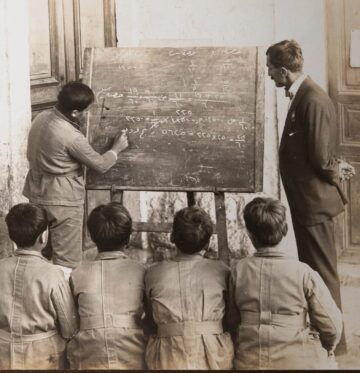
The Alexandropol orphanage was the largest single child-relief operation in the world during the early 1920s. NER built it into a former Russian army barracks complex on the outskirts of Alexandropol (Gyumri), in the new Soviet Republic of Armenia. At its peak, the compound held up to 25,000 children, survivors of the 1915 Armenian Genocide and the subsequent collapse of the short-lived Armenian Republic. NER ran the place as a daily institution, not an emergency shelter: schools, hospitals, vocational shops, a brass band, athletic programs, self-governing units organized by age. A satellite trachoma hospital at Seversky Post treated the endemic eye disease that had reached 5,000 cases in the orphan population by 1920; Dr. Mabel Elliott led the medical staff, and eye specialist Dr. R.T. Uhls oversaw the trachoma program. The Acheson photographs from Alexandropol are mostly institutional — eye-disease clinics at the orphanage gate, nursing students with younger children, calisthenics drills on the parade ground, snow-bound winter scenes. Soviet pressure forced the compound's closure in 1929; the remaining children were transferred to Soviet-run successor institutions.
No known copyright restrictions. Based on available information, NERHS is not aware of copyright restrictions on this material. Items are presented for non-commercial research and educational use. Users are responsible for determining rights status and compliance with applicable law.