
On Film: Near East Relief, 1919–1930
Between 1919 and 1930, American, British and German filmmakers put the aftermath of the Armenian, Greek and Assyrian Genocides on screen. This exhibit presents five of their films.
Films Made to Persuade
None of the films in this exhibit is a neutral record. Ravished Armenia restaged Aurora Mardiganian’s deportation as a feature film to raise money for relief. The U.S. Army Signal Corps filmed the Harbord Mission as the official record of a government fact-finding trip, and in 1937 cut it down to scenes of cities and of the mission’s receptions. Newsreel companies turned the Hardings’ coupon books and the evacuation of Smyrna into stories for movie audiences. A German mission society edited footage from the 1920s into an appeal that ends with a verse from Isaiah. Near East Relief used film the same way and lent its own reels to theaters during fundraising campaigns.
The footage shows real places and people. It was also selected and arranged to win support, and the title cards speak in the language of the campaigns that paid for them.
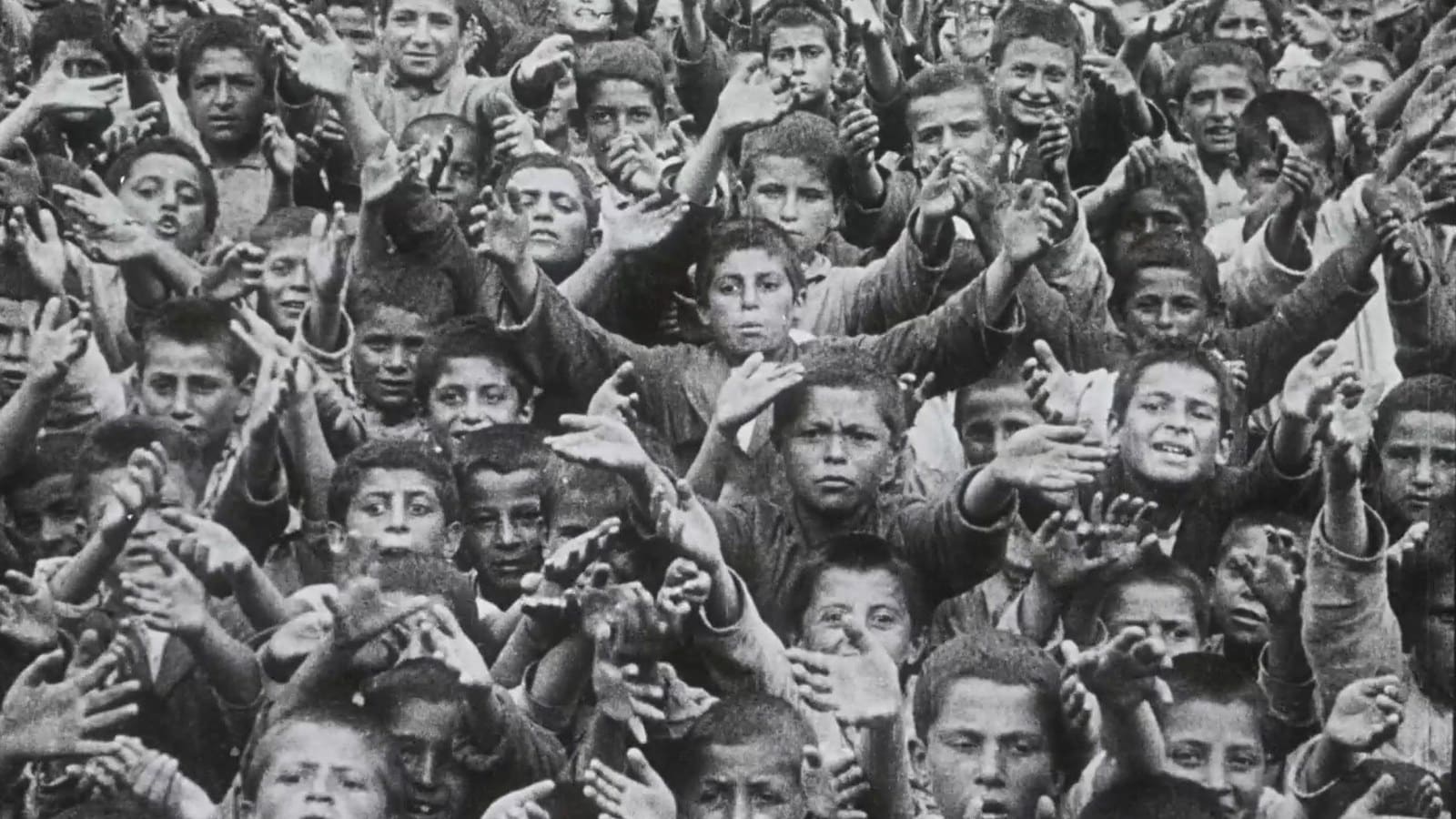
Content note: Ravished Armenia includes restaged scenes of violence against Armenian women, among them crucifixions. Other films show starving and destitute children.
Ravished Armenia (1919), surviving footage, restored in 2009 by the Armenian Genocide Resource Center of Northern California. Internet Archive.
1 · 1919
“See Aurora, Herself, in Her Story”
Aurora Mardiganian survived the Armenian Genocide and played herself in Ravished Armenia, a feature film based on her account. Its sponsor, the National Motion Picture Committee of the American Committee for Armenian and Syrian Relief, used the first screenings in 1919 to raise money. Congress chartered the relief committee as Near East Relief later that year. Only fragments of the film survive.
Read more: Aurora Mardiganian and Ravished Armenia.
Reel 1
Reel 2
American Military Mission to Turkey and Armenia, 1919. U.S. Army Signal Corps. National Archives, 111-H-1226.
2 · 1919
The Harbord Mission
In September and October 1919, Major General James G. Harbord led an American military mission from Constantinople (Istanbul) across Anatolia to Armenia. It was to report on conditions in the region while the United States considered a mandate for Armenia. A Signal Corps cameraman, Private C. F. Gordon, filmed the journey.
Reel 1 runs from Constantinople to Erzinjan (Erzincan). It shows the warehouses of the American Committee for Relief in the Near East at Oulou-Kishla, two of the committee’s workers among the reception committee at Mardin, the mission at Harpoot (Kharpert), and Harbord’s visit to a Turkish orphanage run by the Turkish Red Cross. Reel 2 continues to Erzerum (Erzurum), Kars and Erivan (Yerevan), where Prime Minister Alexander Khatisian and his cabinet received the mission, and ends at Trebizond (Trabzon), where the mission sailed for home.
Fox News story 4086, April 5, 1921. Moving Image Research Collections, University of South Carolina.
3 · 1921
A Coupon Book for One Child
On April 5, 1921, President Warren G. Harding and Florence Harding each accepted a Near East Relief coupon book. Each book paid for the care of one Armenian child through the organization’s child-sponsorship campaign. A Fox News camera filmed the visit for the newsreels.
Burning of Smyrna, September 1922. British Pathé.
4 · 1922
Smyrna Burns
Turkish Nationalist forces entered Smyrna (Izmir) on September 9, 1922. Four days later fire swept through the Armenian and Greek quarters. Most historians conclude that Turkish forces set it. Hundreds of thousands of refugees crowded the waterfront, and most of those evacuated were taken to Greece. British Pathé footage shows people climbing from rowing boats onto ships and waiting in line for bread.
Read more: The Burning of Smyrna, in Answering the Call, and The New Near East for October 1922.
From Armeniernot und Christenhilfe (1930), scene 1. Bundesarchiv, Armeniernot und Christenhilfe, Film: 54842.
From Armeniernot und Christenhilfe (1930), scene 1. Bundesarchiv, Armeniernot und Christenhilfe, Film: 54842.
5 · Filmed c. 1922
Carried to Safety
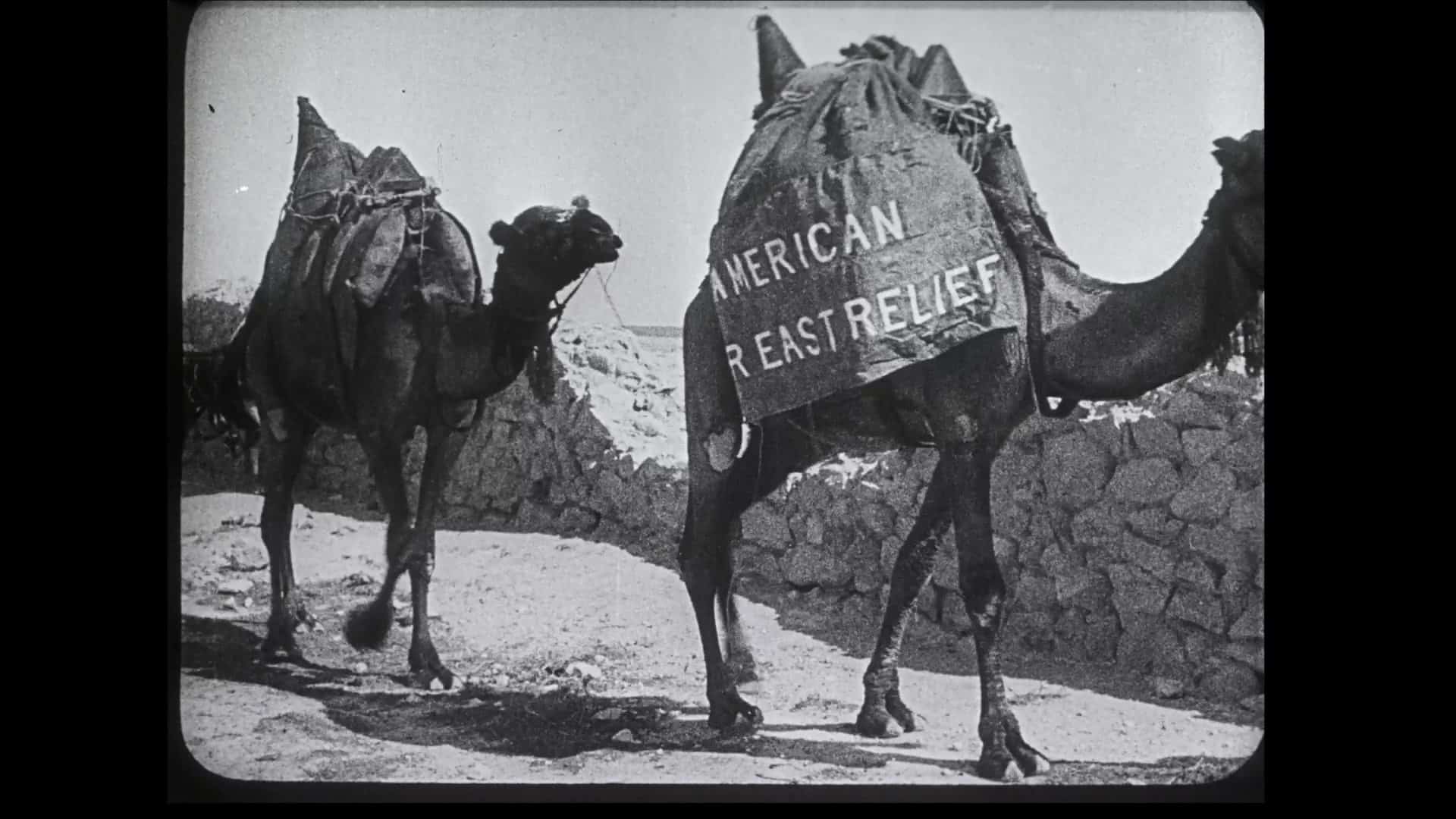
In the early 1920s, Armenian orphans were moved out of Anatolia to Syria in long caravans. A German mission film credits the Swiss relief worker Jakob Künzler with 8,000 of them. Its footage shows camels carrying loads marked American Near East Relief.
Read more: The New Near East for November 1922 and January 1923.
From Armeniernot und Christenhilfe (1930), scene 3. Bundesarchiv, Armeniernot und Christenhilfe, Film: 54842.
6 · Filmed c. 1923–1927
Refuge in Greece
The same film says that 22,000 orphans were brought to safety in Greece and supported by “the American relief organization,” that is, Near East Relief. They lived at the foot of the Acropolis in Athens and on the island of Syra (Syros). The camera filmed a ship crowded with children, an outdoor meal for hundreds of children, and boys marching past the Temple of Olympian Zeus.
Read more: The New Near East for March 1923, and the Dispatches on Athens and Syra.
From Armeniernot und Christenhilfe (1930), scene 13. Bundesarchiv, Armeniernot und Christenhilfe, Film: 54842.
7 · Filmed 1920s
Little Birds That Found a Nest
Near its end, the film sets children still “outside” in the camps against children cared for “inside,” and calls those inside “little birds that have found a nest.” The same name, the Birds’ Nest, belonged to the Near East Relief orphanage at Sidon (Saida) in Lebanon, run by the Danish missionary Maria Jacobsen. In 1928 her mission society, the Danish Women Missionary Workers, bought Near East Relief’s orphanage at Jbeil (Byblos), and the Birds’ Nest moved there.
Read more: The New Near East for December 1923, and the Dispatch In a Little Boy’s Face: Antranig Karjian and the Birds’ Nest.
About These Films
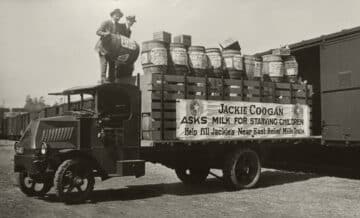
Near East Relief also produced films of its own. Newsreel companies let their cameramen film relief work for the committee’s exclusive use, and twice the committee hired camera operators in Europe to film it. The footage was arranged into reels with descriptive titles. The reels were shown in schools, churches and public gatherings, and lent to movie theaters during local campaigns. James L. Barton’s 1930 history, Story of Near East Relief, lists sixteen titles, among them Alice in Hungerland, Seeing Is Believing and Romance of a Rug, “and others.” The films in this exhibit were made by others: a commercial studio, the U.S. Army Signal Corps, two newsreel companies and a German mission society.