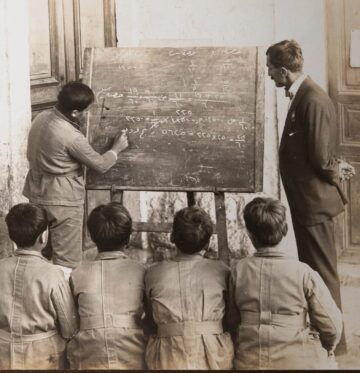
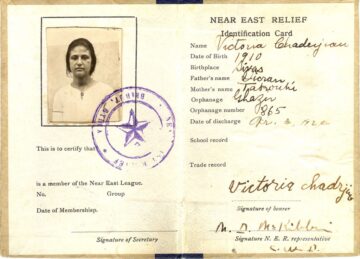
A modest fundraising campaign became a nationwide movement uniting presidents, celebrities, and schoolchildren around a common cause.
A living memorial to the more than 1,000 Americans and international colleagues who served, 1915–1930.
First-person accounts from relief workers and survivors
In-depth stories from the orphanages, relief workers, and campaigns of Near East Relief

Browse archival collections from NER relief workers and orphanages across Armenia, Greece, Lebanon, Syria, and Turkey.
Follow Armenian orphans from Anatolia to NER orphanages around Beirut.
Follow NER’s overseas operations through Barclay Acheson’s photographs, 1922–1928.
Read NER’s field reports, photographs, and appeals in its periodicals.

Trace a family story, teach this history, or conduct original research. Start here to find the right path into the archive.
Search by orphanage location and contribute family documents
Primary sources, research tools, and archival guides for students and scholars
Curriculum guide, documentary, and panel exhibit for the classroom
Find Near East Relief archives worldwide
Location
Year
Item Detail
Cairo, April 1930 — A note from R.M. Davidson on Near East Relief (Egypt) letterhead introducing E.P. Lawton, a U.S. vice-consul newly promoted to consul and assigned to Athens.
Context
Christopher C. Thurber (d. 1930), of Norwich, Connecticut, was a Near East Relief (NER) worker who served in Turkey and Greece during the organization’s peak relief and resettlement years. Arriving in 1921, he directed the NER orphanage at Sivas (Sebastia), survived typhus, and helped lead the evacuation of thousands of orphans from the Anatolian interior to Constantinople (Istanbul) and Greece after the 1922 Smyrna (Izmir) catastrophe. At the Selimiye Barracks refugee camp in Scutari (Üsküdar), he was beaten on the feet by local authorities for shielding a refugee, an injury that left him walking with a cane. From 1924, he directed NER’s work in Greece from Athens, overseeing orphanage education and the resettlement of orphanage graduates. He suffered a stroke and died in late May 1930; the Greek government honored him with a state funeral and a national day of mourning.
The collection gathers correspondence and papers associated with Thurber, preserved among the papers of NER administrator Henry C. (H.C.) Jaquith and received by the Near East Foundation — NER’s 1930 legal successor — as part of the Jaquith collection (now at the Rockefeller Archive Center, FA406). Most items are letters Thurber received from former NER wards and refugees across Greece — Athens, Salonica (Thessaloniki), Piraeus, Corinth, and Zante (Zakynthos) — who addressed him as “father,” thanked him, repaid loans, sent birthday greetings, and appealed for help with work, housing, and passage. Several of the latest letters date from the weeks just before his death.
Rockefeller Archive Center
Harold C. Jacquith (Series 13), Near East Foundation Records, Rockefeller Archive Center.
No known copyright restrictions. Based on available information, NERHS is not aware of copyright restrictions on this material. Items are presented for non-commercial research and educational use. Users are responsible for determining rights status and compliance with applicable law. If you believe you hold rights in this material or have information about rights holders not currently reflected, please contact [email protected].
Typed letter (1 p.) dated 12 April 1930.