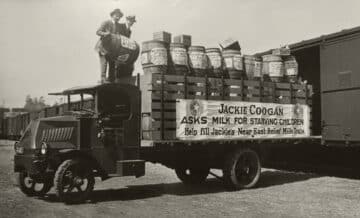
Jackie Coogan and Boy Scouts, Near East Relief milk campaign, 1924
Location
United States
Year
1924
Item Detail
Jackie Coogan and Boy Scouts cooperate in a Near East Relief milk campaign, 1924
Context
In 1924, child actor Jackie Coogan (1914–1984) — already a household name as Charlie Chaplin's co-star in The Kid (1921) — led NER's Children's Crusade, a 10,000-mile cross-country tour visiting 25 American cities.
Admission to a Jackie Coogan movie that summer was a can of condensed milk. In Brooklyn alone, August 16 was declared "Jackie Coogan Day," with over 100,000 children attending. The campaign culminated on September 6, 1924, when Coogan departed New York Harbor aboard the SS Leviathan with more than $1 million in donated cargo — the "Million Dollar Milk Ship." His European tour included an audience with Pope Pius XI in Rome and recognition by the Greek Orthodox Church and the Greek government in Athens, where he visited NER's Zappeion Orphanage.
The Children's Crusade marked a turning point in NER's domestic strategy. The campaign was explicitly built around children giving to children: American schoolchildren were positioned not as passive recipients of adult charity but as agents of their own philanthropic action.
No known copyright restrictions. Based on available information, NERHS is not aware of copyright restrictions on this material. Items are presented for non-commercial research and educational use. Users are responsible for determining rights status and compliance with applicable law.