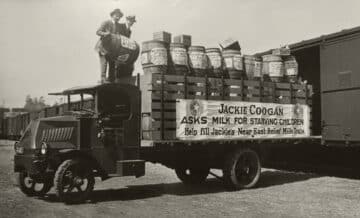
"Missouri Fills the Grain Bag" — Farmers fill the “largest grain sack in the world” for Near East Relief, 1921
Context
Missouri farmers fill what The New Near East called "the largest grain sack in the world," a visual centerpiece of the 1921 "Say it with Flour" campaign. Local grain campaign committees in Missouri counties built oversized sacks like this one to dramatize the volume of food they were asking each district to contribute, turning an abstract appeal into a concrete community goal.
Farmers across the American Midwest and Canada answered with thousands of bushels of grain that NER shipped to feed Armenian and Greek orphans through the winter of 1921–22.
No known copyright restrictions. Based on available information, NERHS is not aware of copyright restrictions on this material. Items are presented for non-commercial research and educational use. Users are responsible for determining rights status and compliance with applicable law.
The grain campaign responded to the September 1920 Turkish invasion of Armenia, which triggered a severe food crisis. Local grain campaign committees in Missouri counties adopted this novel visual appeal. NNE February 1921 covered the flour/grain campaign extensively.