Silent film star Charles Ray contributes to Bundle Day, 1924
Location
Los Angeles, California, United States
Year
1924
Item Detail
Silent film star Charles Ray delivers his bundle of donated clothing for Near East Relief Bundle Day, 1924
Context
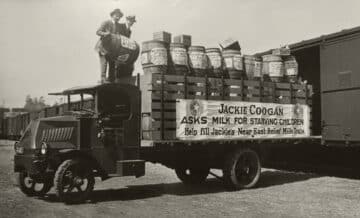
Silent film star Charles Edgar Ray (1891–1943) delivers his bundle of donated clothing for NER's 1924 Bundle Day. Ray was one of the most popular American actors of the late 1910s and early 1920s, known for wholesome rural characters in films like The Old Swimmin' Hole (1921); at his peak he earned $11,000 a week. His participation was part of a deliberate Hollywood engagement with NER that included Jackie Coogan, Betty Blythe, and other screen stars — what would later be recognized as one of the earliest examples of celebrity "cause marketing" in American philanthropy.
The image is a study in scale. Ray, the millionaire actor, was doing the same thing that thousands of Boy Scouts and ordinary American households were doing the same week: assembling a bundle of clothing for Armenian and Greek orphans. That juxtaposition was NER's domestic strategy in microcosm — citizen philanthropy meant the celebrity and the schoolchild participated in the same campaign, with the same gesture.
No known copyright restrictions. Based on available information, NERHS is not aware of copyright restrictions on this material. Items are presented for non-commercial research and educational use. Users are responsible for determining rights status and compliance with applicable law.