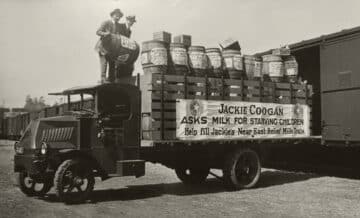
On September 6, 1924, Jackie Coogan departed New York Harbor aboard the SS Leviathan — the same ship that, five years earlier in February 1919, had carried the first NER relief workers to the Near East. The vessel's hold now carried the harvest of his summer-long Children's Crusade: more than $1 million in donated cargo (roughly $18 million in present-day terms), predominantly condensed milk, flour, corn syrup, and clothing collected from American children and their families. His European tour included an audience with Pope Pius XI in Rome and recognition by the Greek Orthodox Church and the Greek government in Athens, where he visited NER's Zappeion Orphanage.
The Milk Ship was the culmination of nine years of citizen philanthropy. It demonstrated, more vividly than any previous campaign, what coordinated American giving at scale could achieve when the appeal moved from print and posters to a single, photographable moment. The October 1924 issue of The New Near East featured Coogan posing in front of the Leviathan — an image that became one of the most reproduced photographs of NER's campaign era.
No known copyright restrictions. Based on available information, NERHS is not aware of copyright restrictions on this material. Items are presented for non-commercial research and educational use. Users are responsible for determining rights status and compliance with applicable law.