Location

Location Unconfirmed

Year

1919–1920

Item Detail

At the receiving station, a child was deloused and bathed. They burned the old clothes and issued clean ones. She stands here in the smock and the white head kerchief that were given to her, at the same wire fence as the first portrait, and still barefoot. This is the second of the three, made immediately afterward.

Context

Silas Hertzler (1888–1975) served in Syria from January 1919 to March 1920, first under the American Red Cross and, from 1 April 1919, under the American Committee for Relief in the Near East. He was one of seven young volunteers the Mennonite Relief Commission for War Sufferers sent on the relief ship Pensacola on 25 January 1919. After a few months in the Beirut transport department, he went to the Sidon district, where William Stoltzfus directed the work, and Hertzler was responsible for three hundred boys in the orphanage. Many of the children had been orphaned by the Armenian Genocide or by the wartime famine in Mount Lebanon. He taught at Goshen College from 1920 to 1958.

The collection draws on his loose prints and relief photograph album at Goshen College Archives. It records the Sidon orphanage and its trade shops, the Armenian refugee barracks at Aleppo, the Syrian Orphanage at Jerusalem, and the Antoura orphanage, where Ottoman authorities had tried to make Armenian children Turkish. Three portraits follow one girl, Miriam Moosa, from her arrival to six months later. Some prints show places he is not known to have worked, among them Konia and Smyrna.

View in the Digital Archive
  • Holding Institution

    Goshen College Archives, Goshen College. Goshen, Indiana.

  • External Link

  • Attribution

    Silas and Anna Weaver Hertzler Papers. Middle East Photographs, 1919–20. HM1/197, Box 19–20. Goshen College Archives, Goshen College, Goshen, Indiana.

  • Rights

    This material is subject to restrictions. Permission from the rights holder or holding institution may be required for reuse. Please consult the source repository for additional information. If you believe you hold rights in this material or have information about rights holders not currently reflected, please contact [email protected].

  • Notes

    Original caption: "No. 2, Miriam Moosa. Immediately after being prepared to be received."

    HM1/197, Box 19, Folder 2.

    For the receiving-station procedure behind the phrase "prepared to be received," see the first portrait in this sequence. News Bulletin, vol. II no. 6, November 1918, p. 2, describes it in one case: a girl "was given a hot bath, her old garments burned and in the new clean ones she looked like a new creature though so white and emaciated after months and months of semi-starvation."

    Sequence: the second of three portraits.
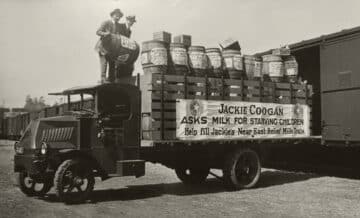
Miriam Moosa, washed and clothed on arrival. c. 1919–1920.