Location

New York

Year

1921

Item Detail

Clothing was itself a form of relief for refugees and children who had lost their homes and possessions. Near East Relief organized Bundle Day collections in the United States, then sorted and shipped the garments through its warehouses. This issue traces used clothing from American donors to warehouses, refugee camps, orphanages, and workshops in the Near East. Reports describe the Talas compound, an orphanage of 1,000 children at Samsoun, clothing distribution at Batoum, and an industrial factory at Adana. The issue also considers Armenian staff taking greater responsibility for institutional work.

Context

The New Near East was Near East Relief's monthly publication that reported on the organization’s work and mobilized financial support from American readers. Its articles preserve evidence of field conditions and institutional decisions, but they frame that evidence through Near East Relief’s own appeals for support.

View in the Digital Archive
  • Holding Institution

    Rockefeller Archive Center

  • External Link

  • Attribution

    Near East Foundation Collection, Rockefeller Archive Center

  • Rights

    No known copyright restrictions. Based on available information, NERHS is not aware of copyright restrictions on this material. Items are presented for non-commercial research and educational use. Users are responsible for determining rights status and compliance with applicable law. If you believe you hold rights in this material or have information about rights holders not currently reflected, please contact [email protected].

  • Notes

    Masthead: Vol. VI, No. 8, May 1921. Published by Near East Relief, New York.

  • Document Contents

    * “Prune the Clothes-Tree” organizes the Bundle Day campaign and asks American households to send usable garments.

    * “How the Press Helps Armenia” reprints a Boston Herald editorial on American relief for Armenia.

    * “The Scarecrow on the Doorstep” prints Elizabeth Anderson’s account of Petros Martirossian, who could not leave a hospital because no men’s clothing was available.

    * “Developments in the Near East” reviews political and military changes after the Treaty of Sèvres.

    * “Spare That Tree” and “Scars on the Hill Slopes” describe the Talas hospital compound and damage to its orchards and vineyards.

    * “The Milk Route” presents Near East Relief feeding work from Samsoun to Harpoot.

    * “Assuming Their Responsibilities” prints Melville Chater’s report on Armenian staff and the remaining American director at the Samsoun orphanage.

    * “The Journey of the Bundle” follows donated clothing from collection and sorting in the United States to overseas shipment.

    * “Mobs Shouting for Clothes,” by Kate Clough Rambo, recounts clothing distribution at Petoeva Barracks in Batoum.

    * “Gipsying in the Sultan’s Chiftlik” describes refugees living on a former imperial farm near Ismid.

    * “The Beehive at Adana” describes production and employment in a Near East Relief industrial factory.

    * “Near East Fashions” documents patched garments and seasonal clothing needs.
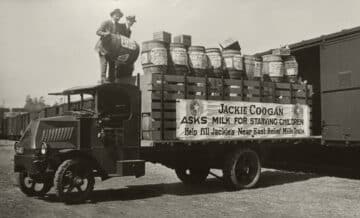
Bundle Day clothing reaches camps and orphanages. New Near East, May 1921.