Collections
NER schools educate and train 100,000 children. New Near East, Oct 1920.
Location
Constantinople (Istanbul)
Year
1920
Item Detail
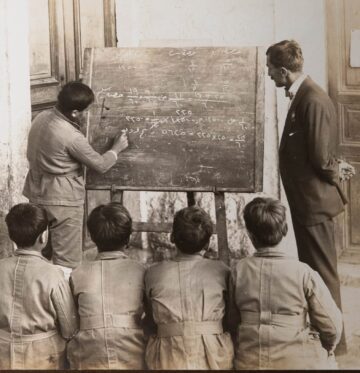
The First Republic of Armenia faced renewed war and an uncertain future, and Near East Relief put forward education as its answer to the destruction of Armenian families, schools, and community institutions. This education issue examines Armenian schools and a program reaching more than 100,000 children. Articles describe teacher training, child self-government, language and cultural instruction, textile work, and fundraising by New York public school students. Charles V. Vickrey reports about 10,000 orphans at Alexandropol, 6,000 at Kars, and 3,000 at Erivan.
Context
The New Near East was Near East Relief's monthly publication that reported on the organization’s work and mobilized financial support from American readers. Its articles preserve evidence of field conditions and institutional decisions, but they frame that evidence through Near East Relief’s own appeals for support.
-
Holding Institution
Rockefeller Archive Center
-
Attribution
Near East Foundation Collection, Rockefeller Archive Center
-
Rights
No known copyright restrictions. Based on available information, NERHS is not aware of copyright restrictions on this material. Items are presented for non-commercial research and educational use. Users are responsible for determining rights status and compliance with applicable law. If you believe you hold rights in this material or have information about rights holders not currently reflected, please contact [email protected].
-
Notes
Masthead: Vol. VI, No. 1 (Total No. 41), October 1920. Published by Near East Relief, New York.
-
Document Contents
* “Of Maps and Map Makers” explains the Treaty of Sèvres map and proposed territorial arrangements for the former Ottoman Empire.
* “Armenia’s Educational Ideals and Efforts” traces Armenian schools and the Union of Armenian Schools under Ottoman rule.
* “America Educating One Hundred Thousand Children in Armenia” describes school and industrial instruction and reports that 422 of 659 children at one orphanage could not speak Armenian when they arrived.
* “Child Self-Discipline in Near East” describes children’s courts, child police, judges, and penalties in orphanages.
* “Educational Work School for Teachers” reports a three-week course for 80 participants from Talas, Caesarea, and Zinjirdere.
* “The Armenians” surveys Armenian history, statecraft, scholarship, and art.
* “Intellectual Renaissance” traces missionary and Armenian education from 1820 through several colleges in Anatolia and Syria.
* “An Achievement and an Appeal” reports that New York public school students donated 3,400,000 pennies, or $34,000.
* “Mr. Vickrey’s Report” states that American food aided Armenia through the previous winter and gives orphan counts for Alexandropol, Kars, and Erivan.
* “I Wonder” asks whether Americans will forget children who face starvation.
* “The School Mistress of the East” describes Near East Relief education and trade instruction for more than 100,000 children.
* “Textile Notes from the Near East” reports cloth production and dye experiments at the Caesarea orphanage.
* “The Baby Who Would Not Smile” tells the story of Najeebe, an orphan found during the 1918 famine in Syria.