Location

Ghazir, Lebanon

Year

1922

Item Detail

The blackboard carries fractions and multiplication in Arabic script and numerals. An instructor in a suit watches from the right of the easel while the rest of the class waits its turn on the ground.

Context

Bayard Dodge (1888–1972) taught at the Syrian Protestant College, later the American University of Beirut, and was its president from 1923 to 1948. The son of Near East Relief's treasurer, he helped build the network of orphanages that received Armenian children moved south out of Anatolia, and in April 1921 he secured French assurances that 1,000 children from Marash and 700 from Urfa could enter Syria.

The album records that movement and its aftermath through 1921 and 1922: the refugee camp at Alexandretta, the convoys out of Marash, the sailing of 1,500 Harpout orphans to Constantinople in September 1922, and the orphanages at Aleppo, Antilyas, Jebail, Nahr Ibrahim, Sidon, Miamia, Ghazir and Shemlan. A December 1922 count puts some 10,740 children in the Beirut-area institutions. Most were survivors of the Armenian Genocide.

View in the Digital Archive
  • Holding Institution

    American University of Beirut, Archives and Special Collections

  • Attribution

    Bayard Dodge Photograph Albums, Volume IV, American University of Beirut, Archives and Special Collections; digital surrogate by the Near East Foundation.

  • Rights

    Some materials may be protected by U.S. copyright law. Materials are presented for non-commercial research and educational use under fair use. Uses beyond fair use may require permission from the copyright owner. Responsibility for rights determination and compliance rests with the user. If you believe you hold rights in this material or have information about rights holders not currently reflected, please contact [email protected].

  • Notes

    Album card: “Ghazir.” Handwritten on the prints: “Arithmetic” “Shoemaking” “Clinic.” “Drill.”

    The Near East Relief Newsletter, Vol. III No. 5, 4 February 1921, p. 1, "The Orphans of Syria," places the Ghazir children "in the buildings of a monastery, and in several other rented houses" and "under the direction of Mr. and Mrs. Moultrie of the Near East Relief," with "Christians, Moslems, and Druzes" mingling "in school classes and industries with the greatest harmony."
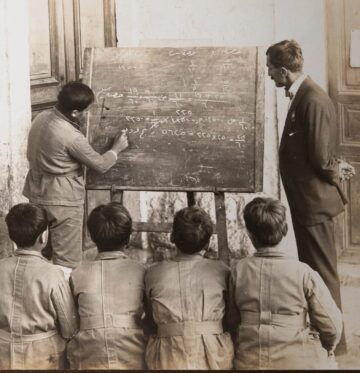
A boy works on arithmetic on the blackboard. Ghazir, 1922.