
Before Antranig Karjian died in 2014 at age ninety-four, he had given his daughters a photograph from his childhood: a small boy saying grace over a bowl of food. It was the only photograph he had from his time growing up at a Near East Relief orphanage. His daughter Lucine wrote to the Near East Foundation to ask about it.
Dispatches
In a Little Boy’s Face: Antranig Karjian & the Birds’ Nest
Children saying grace at the dining table of the Birds' Nest orphanage in Sidon (now Lebanon), c. 1925. Antranig Karjian appears second from the right.
Searching for Antranig
NERHS receives many such inquiries from descendants of Near East Relief orphans. Some families have photographs; most carry no identifying information. Survivors of the Armenian Genocide often did not speak of their experiences with their children or grandchildren, and few set down written memories. When the records do not survive, NERHS can usually offer only an educated guess about where and when a photograph was taken.
Closeup of Antranig Karjian saying grace at the Birds' Nest orphanage in Sidon (now Lebanon), c. 1925
Lucine’s photograph turned out to be one of the rare ones that could be matched.
In 2013, David Mann, son of Near East Relief worker Nellie Miller Mann, had published his mother’s letters and photographs as Letters From Syria, 1921–1923: A Response to the Armenian Tragedy, Including Stories, Travel and Reports. He had also given the materials to the NEF archives. Lucine’s photograph was identical to one in the Nellie Miller Mann Collection.
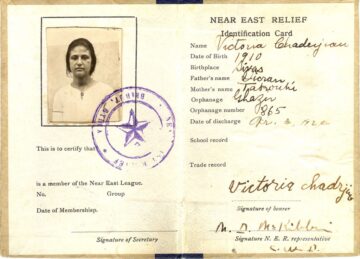
A few months later, Lucine was watching a NERHS Kickstarter video that featured a small set of orphan photographs from the archive. Unlike most archival photographs of Near East Relief orphans, these came with names and some identifying details. Lucine recognized one of the entries: “Orphan No. O.S. 698 – girl – Gulania Kardjian.” The little girl was her Aunt Vartouhi.
Orphan registration card for "Gulania Kardjian" (Orphan No. O.S. 698), Antranig Karjian's older sister Vartouhi
Struggling to Survive
Like thousands of Armenians, Lucia Elmjian Karjian was deported from Marash, Turkey, in 1915. Her husband, Garabed, had been sent to Syria earlier. Lucia marched on foot for hundreds of miles with her four-year-old son, Manase, and her one-year-old daughter, Vartouhi. The three reached safety in Damascus, Syria, where Garabed found her.
The reunion did not last. A Turkish gendarme noticed Lucia, killed Garabed, and seized her and her children as captives. She was pregnant with her third child at the time of Garabed’s death. She gave birth to a son on a snowy winter night in 1920 and named him Antranig.
Lucia and her children were held in the gendarme’s home for several years. She eventually escaped with the three children, left Damascus, and made her way to Aleppo. With help from the Armenian Presbyterian Church, she found a cousin in Aleppo. She soon realized she could not support her family on her own. The Reverend Aharon Jirejian gave her a small sum of money and a letter of introduction to the Birds’ Nest, a Near East Relief orphanage in Sidon*, Syria (now Lebanon). It was not uncommon for widowed women to place their children in Near East Relief care while they tried to rebuild a life. Lucia made another long journey, of nearly two hundred miles, to bring her two younger children to Sidon.
* The Birds’ Nest moved from Sidon to Jubeil in 1928.
"Golden Rule Children" spread in The New Near East. Nellie Miller Mann's photograph of Antranig Karjian and other children saying grace at the Birds' Nest dining table appears at lower center, captioned "A happy meal hour in the orphanage. Fun is the heritage of normal children." Courtesy of Vicken Babkenian.
Separation and Reunion
Vartouhi (also called Gulania) and Antranig came under the care of Danish missionary and Near East Relief worker Maria Jacobsen and her staff. Jacobsen called the children “birdies” because they reminded her of baby birds asking for food. Nellie Miller Mann, a Near East Relief worker in Beirut, traveled to the Birds’ Nest often. She loved the children there and photographed them many times. One of her photographs of Antranig and other children at the dining table appeared in a New Near East magazine spread on Golden Rule children.
Lucia found work as a maid in Aleppo and saved her wages toward reuniting her family. She brought Antranig and Vartouhi home to Aleppo in 1926 or 1927, after about two years at the Birds’ Nest. Vartouhi went to work in a tailor’s shop. Antranig enrolled at the Armenian Presbyterian school. Manase enlisted in the French Army and left Syria. Before Antranig left Sidon, an Armenian teacher at the Birds’ Nest gave him a photograph of himself saying grace with other children. It would remain his only memento of the orphanage years. He kept it for the rest of his life.
The Karjian family moved to Baghdad a few years later, after Vartouhi married an Armenian refugee from Erzerum who had also survived the Genocide. Antranig later immigrated to the United States with his wife and four daughters and ran a photo studio there for many years. He rarely spoke of his time in the orphanage. At Christmas, he would sing “Silent Night” in Armenian.
He had learned the carol at the Birds’ Nest.
Credits and Acknowledgments
Special thanks to the Karjian family for sharing this story. This Dispatch is adapted from a family history that Lucine Karjian developed with NERHS for They Shall Not Perish: The Story of Near East Relief, a teachers’ guide produced in partnership with The Genocide Education Project. Molly Sullivan wrote the original account.
Photographs of Antranig Karjian and the children of the Birds’ Nest are from the Nellie Miller Mann Collection, courtesy of David Mann. The “Golden Rule Children” magazine spread is courtesy of Vicken Babkenian. The orphan registration card for Gulania Kardjian is from the Near East Foundation Records, box 156.