On February 16, 1919, the troopship Leviathan steamed out of New York harbor carrying two hundred and fifty doctors, nurses, teachers, and builders bound for the postwar Near East. They were the first large American relief delegation to enter Turkey after the Armistice. History would remember them as the Leviathan Party.
Dispatches
Leviathan, 1919: Near East Relief’s Pioneering Mission
Members of the Leviathan Party of Near East Relief workers, en route to the Near East, February–March 1919. NER service stars are visible on the hats of several workers.
Ready to Make History
On February 16, 1919, a party of 250 set off for the postwar Near East. The group included doctors, nurses, researchers, builders, and educators. Their backgrounds varied but their mission was shared: relief work for the people of the Near East. They sailed as representatives of the American Committee for Relief in the Near East (ACORNE), which would be renamed Near East Relief by Congressional charter in August 1919.
The ACORNE volunteers were led by Dr. George White, former president of Anatolia College in Marsovan (Merzifon). White had been forced from Turkey in 1916 after the college’s Armenian faculty was murdered, and he was committed to rescuing Armenian women and children still held in captivity. The party included educators like Mary Hubbard, a schoolteacher from Tarrytown, New York who spoke fluent Armenian, and five experienced kindergarten teachers.
New York Times headline announcing the Near East Relief expedition aboard the Leviathan, February 17, 1919.
Dr. Mabel Elliott (seated) with two American Women's Hospitals nurses bearing the AWH insignia, Alexandropol, c. 1919–1922. Library of Congress.
Fearless Women
Most of the ACORNE volunteers were accomplished women. The medical staff included Blanche A. Blackman, assistant director of Cincinnati General Hospital; sixty nurses on loan from the American Red Cross; and seven bacteriologists. American Women’s Hospitals sent five women physicians, including Dr. Mabel Elliott and Dr. Ruth Parmelee. Smith and Wellesley Colleges each sent five women hospital workers.
The ship also carried $3.5 million worth of supplies.
The Leviathan itself had a wartime history. Built in Germany as the Vaterland, the liner had operated between Hamburg and the United States and briefly held the title of the world’s largest passenger ship. It had just completed a trip to the U.S. when war broke out in 1914 and remained docked in Hoboken, New Jersey, until the United States entered the war three years later. In 1917, the United States Shipping Board commandeered the Vaterland as a troop transport, and President Wilson rechristened it the Leviathan. It was still technically a warship when it sailed with the ACORNE party. Full decommissioning would not come until October 1919, and the voyage to Europe was made in full blackout.
A Lifesaving Mission
The ACORNE party disembarked from the Leviathan in Brest, France, on February 23. From there, they boarded a Red Cross train across France to the port city of Marseilles, sailed on to Constantinople with a stopover in Salonika, Greece, and landed in Constantinople on March 8 after a journey of about three weeks.
A group of ACORNE Commissioners had preceded them. The Commission had left the U.S. on January 4, 1919, to survey the organization’s territory and assess the refugee situation for the coming year, and it included both civilian volunteers and military officials. ACORNE co-founder Dr. James L. Barton was among them and was waiting to greet the Leviathan Party in Constantinople. The Commissioners had already begun to relieve the exhausted missionaries who had remained in the Near East throughout the war and who had distributed relief funded by the Committee. Barton’s party included Dr. Edward C. Moore of Harvard and the American Board of Commissioners for Foreign Missions (ABCFM); Dr. William W. Peet, longtime treasurer of the American Board of Commissioners for Foreign Missions in Constantinople; Dr. J.H.T. Main, president of Grinnell College; and Dr. George H. Washburn, head of the medical unit and son of the late George Washburn, former president of Robert College.
It took several months for the new relief workers to receive their assignments. Barton and his fellow commissioners led groups into the Turkish interior on the Baghdad Railway, which the British army had placed at ACORNE’s disposal. Workers reached Adana, Konia, Mardin, Urfa, Aleppo, and Beirut by rail with boxes of supplies. Others began the longer journey to the Caucasus to join the longtime medical missionary Dr. Clarence D. Ussher in Erivan and the surrounding area.
The USS Leviathan with tugboat escort, c. 1918–1919. Library of Congress.
Postscript: 1924
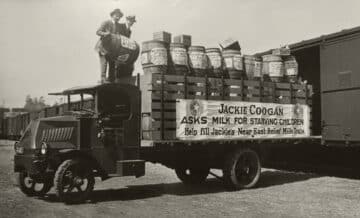
Five years later, the Leviathan carried Near East Relief once more. The ship had been refitted as a civilian liner under United States Lines. The child film star Jackie Coogan boarded on September 6, 1924, en route to deliver more than $1 million in donated food, clothing, and supplies to NER orphanages in Greece, Armenia, and Syria.