The U.S. consular records of Persia document a quarter-century in which Assyrian and Armenian Christians in the country’s northwest were repeatedly caught between Ottoman, Russian, Kurdish, and Persian forces, and in which American diplomats became, by default, the principal humanitarian actors on the ground. This is the second of two dispatches drawn from those records; the first follows the Baghdad consulate.
Dispatches
Persia, 1914–1925: U.S. Consular Reporting on the Armenian and Assyrian Genocides
Gordon Paddock, U.S. consul at Tabriz from before the First World War to the mid-1920s. In May 1919 he led the surviving Christians of Urmia out to safety in Tabriz under the protection of the American flag.
In May 1919, Gordon Paddock, the U.S. consul at Tabriz, walked into Urmia, gathered the Assyrian and Armenian Christians who had survived the Ottoman occupation, and led them out to safety under the American flag. It was one of dozens of episodes preserved in the U.S. consular records of Persia. Ottoman Turkey, Russia, and Great Britain set the country’s course in the early twentieth century, and its Christian minorities — Assyrians most of all — bore the consequences.
The legation in Tehran, established in 1883, was the first U.S. diplomatic post in what was then called Persia (renamed Iran in 1935). Consulates in Tehran and Tabriz followed in the years after. Their staff reported on political, economic, military, and social developments, protected U.S. citizens, promoted American business interests, and handled immigration matters across a region where mass media did not yet exist and diplomatic posts were the principal channel for gathering news and sending it abroad.
Gordon Paddock, U.S. consul at Tabriz, to Charles W. Russell, American Minister at Tehran, February 3, 1913. RG 84, U.S. Consulate Tabriz, National Archives and Records Administration.
William A. Shedd, Presbyterian missionary at Urmia and son of missionary parents, the principal liaison between the Assyrian community and the U.S. consulate at Tabriz. He died of cholera in August 1918 during the mass exodus of Assyrians and Armenians from Urmia.
Christian denominations also operated missions in Persia, often in regions with large Christian minority populations. The Presbyterian mission at Urmia, established by Justin Perkins in 1834, was the oldest and largest American mission in the country and the principal institution serving the region’s Assyrians. Multi-generational missionary families — the Shedds, the Cochrans, the Packards — anchored the work. William A. Shedd, son of Presbyterian missionaries at Urmia and a missionary himself, became the central liaison between the Assyrian community and the U.S. consuls at Tabriz. From the late 1800s onward, the mission arranged for small numbers of young Assyrian men to study in America. Most became naturalized U.S. citizens, and many returned home to Persia. The missionaries and these Assyrian-Americans worked closely with the Tabriz consulate, which had jurisdiction over the broader region.
Persia in the early twentieth century was buffeted by Ottoman Turkey, Russia, and Great Britain, all of which wielded considerable economic, political, and military influence in the country. Border disputes and Turkish and Russian incursions kept the region in frequent conflict. In 1907, the British and Russian governments signed the Anglo-Russian Convention, which divided Persia into Russian, British, and neutral spheres of influence. Venture capitalists and industrialists soon exploited the instability and began extracting natural resources. In 1909, the new Anglo-Persian Oil Company, a predecessor to British Petroleum, began large-scale production.
To maintain supplies to the Royal Navy, which was converting from coal to oil, the British government took a 50% ownership stake in the company in 1914. It deployed troops to the oil-producing areas and reached agreements with local leaders to protect these assets. Russia and Great Britain each controlled one of the two main Persian banks and agreed to divide government revenues to repay the large debts the Persian government owed them.
Although Persia was not a direct combatant in the First World War, the conflict still severely affected it. After the war began in August 1914, Russian troops occupied the Urmia region. Their presence was generally welcomed by the Christian minorities but strongly opposed by the Muslim majority. In early 1915, the Russians withdrew, and an Ottoman force bolstered by Kurds from the mountains along the Persian-Turkish border entered the area. Massacres followed in Assyrian and Armenian farms and villages — part of the wider campaign against Ottoman Christians that has come to be recognized as the Armenian, Assyrian, and Greek genocides. For Assyrians, the killings of this period are remembered as the Sayfo (Syriac for “sword”).
Survivors who could flee reached Urmia, where U.S. missionaries did what they could to provide relief. American diplomats, drawing on resources and contacts unavailable to ordinary citizens, pressed surrounding governments to protect U.S. nationals and the persecuted communities more broadly.
Through 1916 and early 1917, intense fighting between Russian and Ottoman forces ranged across western Persia. The British engaged Ottoman forces in the southwest as they advanced toward Baghdad, which they captured in March 1917. The United States entered the First World War in April 1917 but did not declare war on the Ottoman Empire.
The Bolshevik Revolution that fall led to a quick armistice between Russia and the disintegrating Ottoman Empire. Russian troops in Persia turned to looting and assaulting civilians, particularly Muslims, before withdrawing in early 1918. In March 1918, Simko Shikak, a Kurdish chieftain, assassinated Mar Shimun XXI Benyamin, the Patriarch of the Assyrian Church of the East, during what had been presented as peace negotiations. The killing destroyed the prospect of a negotiated settlement and set the Assyrian community on a war footing. Assyrians and Armenians fleeing persecution joined a local fighting force in the Urmia region, armed with much of the equipment the retreating Russians had left behind, under the command of Agha Petros (Petros Elia of Baz).
This Assyrian-Armenian force fought several battles against local Muslims. The Persian government charged that British, French, and American missionaries and diplomats were supporting it; the three governments denied it. Tehran had little recourse beyond formal protests.
As part of a larger move into the Caucasus, the Ottoman army entered Azerbaijan province in May 1918 and quickly occupied Tabriz. Many Christians and foreign consuls fled south. Ottoman forces also engaged Agha Petros’s army on the Urmia plain. The British military offered supplies and other assistance if the Christians could reach their lines north of Hamadan, but the route proved impassable.
After months of fighting, Ottoman forces reached the outskirts of Urmia. Panic followed. Roughly fifty thousand Assyrians and Armenians fled south toward British military lines — the catastrophic exodus during which William Shedd died of cholera. Many more died along the way from disease or attacks by Ottoman, Kurdish, and Persian forces before reaching the British refugee camps around Hamadan and Baquba. The several thousand Assyrians who remained in Urmia suffered terribly under Ottoman occupation; Judith David, whose husband Jacob had joined the exodus south, was among those who stayed behind and organized food and shelter for the surviving community.
Persian Ministry of Foreign Affairs to the American Legation at Tehran, regarding the legation's distribution of a $5,000 American Red Cross donation for earthquake relief in Turbat. RG 84, U.S. Legation Tehran, National Archives and Records Administration.
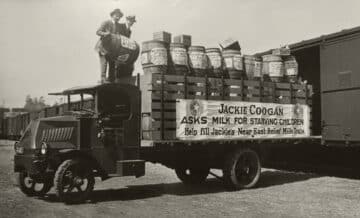
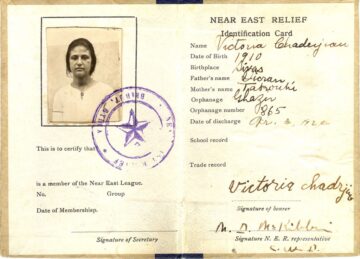
Soon after the Mudros armistice of October 1918, Ottoman troops withdrew from Azerbaijan Province. An uneasy peace held between the remaining Christians in Urmia and the Muslims and Kurds who had returned from their mountain homes. A few American missionaries and Assyrian-Americans returned in the spring of 1919, including Jacob David. In May, fighting broke out between Persians and Kurds, and the violence spilled over into the Christian community. Gordon Paddock, having returned to Tabriz, went back into Urmia and led the surviving Christians out to safety under the protection of the American flag. The American Committee for Armenian and Syrian Relief — later renamed Near East Relief — had been aiding the persecuted minorities in Azerbaijan province since 1916. It and other organizations now assisted the Assyrians and Armenians in Tabriz and in the refugee camps. As before, U.S. diplomats and missionaries led much of the relief effort.
Judith David in Tabriz in 1920 with three of her four children, a year after Gordon Paddock led the surviving Christians out of Urmia under the American flag. The family immigrated to the United States in 1921 and settled in Chicago.
Bolshevik troops landed at Anzali on the Caspian coast in May 1920 and briefly threatened to advance on Tehran. They withdrew the following year, after a Soviet-Persian treaty normalized relations between the two countries. The British were now the only foreign military force left on Persian territory.
With Tabriz facing imminent occupation by Ottoman or Bolshevik forces, almost all the Christians and foreign consuls there fled to Tehran or south to British military lines late in 1920. Fighting between the Persian government and combined Persian rebel and Kurdish forces in Azerbaijan province kept consuls from returning to Tabriz for several years. The Assyrians and Armenians who had fled Urmia and Tabriz between 1918 and 1920, now confined to refugee camps in Hamadan and near Baghdad, sought British and American help to return to Azerbaijan province. Both governments could do little at first against Persian resistance to repatriation. Sustained pressure, combined with the arrival of a new Persian government, eventually allowed significant numbers of Christian families and U.S. missionaries to return to the province in the mid-1920s. Many never returned; the Davids were among them, settling in Chicago in 1921.
Over many years of research at the National Archives, James David located and photographed the documents shown in this dispatch. He contributed to writing this dispatch, which closes a two-part series on the consular records of his family’s flight from Urmia.
The records of the Tehran legation and the Tabriz and Tehran consulates — held in NARA Record Group 84 (Foreign Service Posts) — preserve the operational record of this work. A curated selection from these consular records is gathered in the NERHS collections.