Among the relief workers who sailed for the Near East in the first months of 1919 were two sisters from Berkeley, California: Gertrude Anthony, a 46-year-old teacher of biology and botany, and her sister Amy, a 50-year-old trained nurse. They were the nieces of the suffragist Susan B. Anthony — and they were about to spend the next four years carrying their aunt’s ideals into territory she would not have recognized: the orphanages, evacuation caravans, and refugee camps of the postwar Ottoman world.
Dispatches
Susan B. Anthony’s Nieces
Victims of a massacre of Armenians in Erzerum, W.L. Sachtleben, October 30, 1895
The Hamidian Massacres and the first Armenian Relief Effort
When the American Committee for Armenian and Syrian Relief (later known as Near East Relief) was formed to provide aid to Armenian genocide survivors in 1915, it was not the first time that Americans mobilized for international relief. Some 20 years before, a major relief effort was launched in America to help save the survivors of the Hamidian Massacres, also known as the Armenian Massacres of 1894-1896. Conservative estimates place the death toll at around 80,000, while the highest estimates propose that over five hundred thousand died. Hundreds of thousands more were left destitute, homeless, and in desperate need of aid.
This first relief effort, often overshadowed by its much larger successors and the formation of formal relief organizations, coincided with the rising tide of the first wave of the women’s movement and feminism in the West. Women were increasingly propelled into and inspired to join internationalism by an innate identification with victimized women elsewhere.
American women’s organizations played an especially important role in supporting the Armenian relief movement. In 1895, the National Council of Women of the United States passed a resolution declaring:
“That we deplore the outrages committed upon the Armenians, and record our appreciation of the unflinching heroism of our Armenian sisters in sacrificing their lives in defense of their honor and freedom of conscience, and we earnestly urge our sisters in Great Britain and other countries of Europe to use their influence with their governments that they take immediate action to establish security of life, honor and property in Armenia.”
National Council of Women of the United States, 1895
Championing the Armenian cause were many seasoned humanitarians and prominent American women activists, including Julia Ward Howe of the American Woman Suffrage Association and Frances Willard, leader of the Woman’s Christian Temperance Union (WCTU). Willard argued that the “American spirit and example” had “stimulated the Armenian spirit of independence” that led to their repression. It was, therefore, an American “duty” to provide aid to the Armenians. In 1896, Willard cut short a cycling vacation in northern France to help provide aid to Armenian survivors who had found refuge in Marseille. Many American women missionaries stationed throughout the Ottoman Empire provided direct relief to victims. In March 1896, they were joined by Clara Barton, the first president of the American Red Cross (ARC), who led an ARC mission to the Empire.
The American humanitarian response to the Hamidian Massacres served as a dress rehearsal for the much larger and more organized effort that followed during the First World War. American women mobilized again, in even greater numbers, to help Near East Relief (NER) aid the victims of an even larger catastrophe: the Armenian Genocide.
Near East Relief
During the First World War, some 170 American missionaries — many of them women — remained at their posts in isolated and remote areas of the Ottoman Empire. They included Mary Graffam at Sivas, Grace Knapp at Bitlis, Ida Stapleton at Erzerum, Ruth Parmalee at Harput, Elvesta Leslie at Urfa, Clara Richmond at Talas, Harriet Fischer at Adana, Elizabeth Ussher at Van, Emma Cushman at Konia, and many others. Despite being restrained from large-scale efforts by Ottoman authorities, the missionaries were able to provide limited relief and sanctuary to thousands of Armenian refugees. These restrictions began to ease with the war’s end, greatly expanding the scale and effectiveness of relief operations.
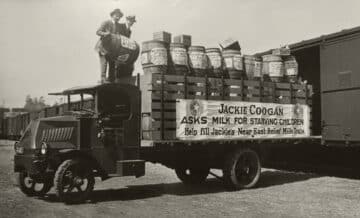
The armistice that ended the war with the Ottoman Empire opened opportunities to send reinforcements of personnel and supplies to the missionary outposts scattered throughout the former Empire. British and French military leaders in the occupied territories of Turkey acknowledged the value of NER for its “complete organization” and its workers’ “familiar[ity] with the language and habits of the people of the country.” With the support of President Woodrow Wilson, NER launched an ambitious citizen-based philanthropy campaign to raise $30 million to meet the urgent needs of Armenian refugees. The equipment of fifteen army hospitals in France, no longer needed in peacetime, was handed over to NER for a nominal sum. Newly acquired equipment included beds, surgical instruments, sterilizers, and medicines. Motor trucks, formerly used for carrying shells and soldiers to the front, were also turned over to the committee for use “in bringing back to their homes the deported refugees and for distributing food throughout the starving districts.”
The Leviathan
In the first months of 1919, a “flotilla of ships” — including the freighters Mercurius, Leviathan, and Pensacola — set sail from New York for the Middle East. Described by The New York Times as the “largest contingent of missionaries, doctors, and relief workers ever sent overseas on such a mission,” the Leviathan alone carried more than 240 people, along with equipment for fifteen hospitals, food and clothing, portable buildings, sixty motor trucks, and other material worth over $3.5 million. Among the passengers were five doctors from the American Women’s Hospitals, an organization established during the war to mobilize American women physicians for service after the War Department had declined to enlist them.
The Leviathan transported the first large group of Near East Relief volunteers in Feb. 1919. Image courtesy of the Library of Congress, Bain Collection.
Among the relief workers aboard the Leviathan were two sisters from Berkeley, California: Gertrude Anthony, aged 46, a teacher of biology and botany, and Amy Anthony Burt, aged 50, a trained nurse. They were nieces of the renowned American suffragist Susan B. Anthony — the namesake of the Nineteenth Amendment, which guaranteed American women the right to vote in 1920.
The Leviathan reached Constantinople in March 1919. Near East Relief soon established a vast network of hospitals, orphanages, and feeding stations for Armenian refugees, extending from the Adriatic to the Caucasus and from Syria to Palestine. NER also opened a number of “neutral houses” that provided sanctuary to Christian women and children released from captivity under the terms of the armistice.
Washington Post Article about Near East Relief Personnel, c. 1919. The article makes special notice of the fact that the relief workers on board were 'chiefly women', demonstrating an early acknowledgment of the invaluable work done by women relief workers for Near East Relief.
A group of women either before or after boarding the Leviathan, c. 1919.
Gertrude and Amy Anthony, c. 1919
Gertrude and Amy Anthony
Amy Anthony was assigned to the large boys’ orphanage at Kooleli, in Constantinople (now Istanbul). Situated on the Asiatic side of the Bosphorus, the Kooleli Orphanage housed about 1,000 children, most of them Armenian. Gertrude Anthony was assigned to the Caucasus, where she worked in Erivan (Yerevan), the capital of the First Armenian Republic.
In a letter from Erivan dated December 26, 1919, Gertrude described the desperate situation of the Armenian refugees:
“By this time there were groups getting breakfast — not much but flour and water gruel with sometimes, a few greens gathered along the river. Those who had any possessions at all had a copper-kettle to cook in, and some had considerable quantities of bedding packed in the native trunks which are big woven cases. But there were many, oh so many, who had nothing, sleeping in the sun, sitting stupidly gazing about, hunting for and chewing mustard stems. A few bought pitiful bits of black bread from dirty peddlers squatted along the [railroad] track.”
Gertrude Anthony, ca. 1919
Gertrude Anthony, c. 1919
In June 1921, after two years in Erivan, Gertrude was assigned to manage the boys’ orphanage at the NER station in Marsovan, Turkey. Her arrival tragically coincided with a large-scale massacre and deportation of Greeks and Armenians in Turkish nationalist-held territory. Bearing witness to the events, Gertrude provided relief to many of the victims.
Gertrude Anthony, Report on Greek and Armenian deportations, Marsovan, November 1921
When she left Marsovan for Constantinople in October of that year, Gertrude submitted a report to the American High Commissioner, Admiral Mark Lambert Bristol. She emphasized that the report included only details she knew “first hand, and such others” as she “felt reasonably certain were correctly told to” her. Aware of Admiral Bristol’s pro–Turkish nationalist sympathies, Gertrude feared that he would not forward her account to the U.S. State Department. To make certain her report reached Washington, she delivered it in person to the State Department in December, on her way home with her sister for a leave of absence. A note attached to the report confirmed her suspicions: Admiral Bristol, it read, had “not transmitted” the report “to the Department.”
Gertrude and Amy returned to Turkey in March 1922. Amy resumed her former work at the Kooleli orphanage. Gertrude, along with two other NER workers — Charlotte Willard of Chicago, Illinois, and Panny G. Noyes of Oberlin, Ohio — was assigned to return to Marsovan to relieve C. Compton of Boston and Sara Corning of Hanover, New Hampshire, who were leaving for vacation. The three women reached Marsovan in June. Gertrude resumed work at the boys’ orphanage, which housed about 600 children. Willard took over as director of relief work and of the premises owned by the American Board of Commissioners for Foreign Missions (ABCFM) and Anatolia College. Noyes took charge of the hospital and the girls’ orphanage. They were the only three Americans there.
Panoramic View of Constantinople, date unknown
After the Turkish nationalist (Kemalist) victory over the Greek Army in western Anatolia and the subsequent Smyrna Catastrophe of September 1922, the nationalists issued an ultimatum: non-Muslims had one month to leave Turkish nationalist-held territory, after which their safety could no longer be guaranteed. The announcement caused panic among the surviving Christian Greeks and Armenians throughout Turkey.
Samsun — the closest major port to Marsovan, and one with a strong American naval presence — became a destination for thousands of terrified refugees from across the northeastern regions of the country. NER headquarters ordered Gertrude Anthony to evacuate Marsovan. She set out on the three-day, sixty-five-mile journey to Samsun with 500 refugees and orphans crowded into a caravan of 56 wagons. Two faster wagons went ahead with workers who could prepare food in advance of the caravan’s arrival.
After arriving safely in Samsun, Gertrude took charge of receiving refugee convoys from the interior. In her own words:
“…were in bad shape for the rains began, and there was snow in the mountains. The ones from Sivas were especially bad, for they had an eight-day trip. There was lots of measles and smallpox and pneumonia …. Refugees were pouring in and mobbing the house and the orphanages in their attempt to get help.”
The existing NER buildings in Samsun could not accommodate the large number of refugees arriving in the port city. The destitute children were so numerous, Gertrude recalled, that NER staff “had [to] select those that looked hungriest.” Clothing supplies were sufficient for the first 300 children; after that, new arrivals had to wear “underclothes and a blanket until we could wash and mend the best of their own clothes. About 600 were taken in ….”
Gertrude decided to return to Marsovan to assist her NER colleagues there. Along the way she saw fleeing refugees whose suffering reminded her of conditions in Armenia. They were, in her words, “[b]arefoot, ragged, dirty with the dirt of weeks of deep muddy roads, worn out with terror and fatigue and hunger, some of them sobbing, some gibbering, some stoical, — facing a blinding sleet storm. One woman with rags that exposed the entire length of her body…”
Gertrude arrived to a similarly desperate scene at Marsovan. Noyes and Willard had been receiving orphans from the NER orphanage further south at Tokat, which housed about 2,000 children. They arrived at Marsovan in batches of 150 en route to Samsun, many bringing with them “cases of smallpox, measles and developed pneumonia.” Mortality was severe; many died on the way or at Marsovan.
Gertrude left Marsovan at the end of January 1923, after most of the orphans had been successfully evacuated from the region. She traveled to Greece to support NER efforts to absorb one million refugees and orphans from Turkey. There, she found, it remained “still a bitter struggle for the refugees” to survive. Many, she said, “are finding places. Many are wrecks and can never recover.”
In late 1923, Gertrude — along with eleven other NER workers — was decorated by King George of Greece with the country’s highest civilian honor, the Golden Cross of Saint Xavier, in “acknowledgment for their services on behalf of Greek refugees and orphans since the Smyrna disaster.” Gertrude remained in Greece, eventually becoming director of the Oropos orphanage, which focused on agricultural education.
Gertrude Anthony, c. 1923
The stories of Gertrude and Amy Anthony are emblematic of the progress American women made in the early twentieth century. In the wake of the Armenian, Assyrian, and Anatolian Greek Genocides, the scale of citizen-based philanthropy and relief required so urgently opened leadership roles that had long been closed to women — even as suffrage and women’s liberation remained hard-fought. As doctors, nurses, teachers, orphanage directors, and relief coordinators, women like Gertrude and Amy Anthony embodied the ideals their aunt Susan B. Anthony had championed a generation before, and pointed the way toward the broader progress still to come for women everywhere, regardless of race, religion, or national origin.
References
Researched in collaboration with Vicken Babkenian, independent researcher with the Australian Institute for Holocaust and Genocide Studies and co-author, with Professor Peter Stanley, of Armenia, Australia and the Great War (NewSouth Publishing, 2016).
- Vicken Babkenian and Peter Stanley, Armenia, Australia and the Great War (Sydney: NewSouth Publishing, 2016).
- Vicken Babkenian, “Humanitarian Responses to the Armenian Massacres 1894–1896,” International Review of Armenian Studies, vol. 16, no. 1, 2018.
- Robert Shenk, America’s Black Sea Fleet: The US Navy Amidst War and Revolution, 1919–1923 (Annapolis, MD: Naval Institute Press, 2012).
- Gertrude Anthony papers, BANC MSS 2002/207, The Bancroft Library, University of California, Berkeley. With thanks to Noushig Karpanian for providing materials from the archive.
- Near East Relief (newsletter), edited by Near East Relief for private circulation, Constantinople, 1921–1922.
Women Relief Workers Aboard the Leviathan, c. 1919