Skip to Main Content

In the summer of 1923, several thousand Armenian and Greek orphans stepped off boats onto the dock at Syra, a small island in the Cyclades. They would spend the next year living in tents, digging wells, and helping to build the dormitories, classrooms, and workshops that would become their home for the rest of their childhoods.

A century later, the orphanage has become an archaeological site, and the material traces of those children are returning to view.

Sailing to Safety

After the burning of Smyrna in September 1922, Near East Relief faced the task of moving more than 20,000 orphans out of Turkey. The Greek government generously offered to accept the majority of these child refugees. On average, the orphans traveled between three and six weeks to reach Greece. With the help of the Greek government, Near East Relief had ferried more than 16,000 children across the Aegean Sea by the end of 1923. About 9,000 of them were Armenian; the rest were ethnic Greeks who had been orphaned and displaced during the genocide of the Anatolian Greek population.

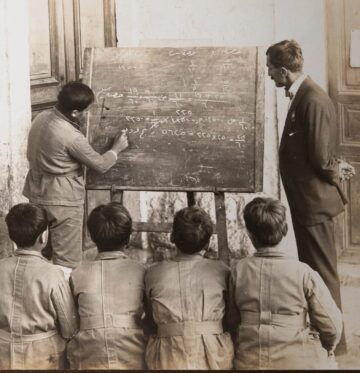
Two of Your Children studying in the window of the Woodrow Wilson orphanage school at Syra, Greece, orphanage farms in the background, 1925.

An Island Home

Although Greece had offered to take the orphans, the existing Greek orphanage system was nowhere near large enough to absorb them. Most of the children spent the summer of 1923 in temporary quarters — beachfront resorts and hotels that had donated space for the cause. Near East Relief had assured the Greek government that the children would not become a long-term burden, and in turn, the government granted the organization the use of a large parcel of land on the island of Syra (Syros), in the Cyclades. The site was chosen for its agricultural potential.

Near East Relief set about building an ambitious orphanage school with dormitories, classrooms, workshops, and play spaces. Adult refugees were hired to help, but most of the labor came from the children who would live there. The orphans slept in tents while construction was underway, and they also dug fourteen donkey-powered wells to supply water to the new facility.

Orphan boys hoe the onion field, Syra, March 1927

Supplies From America

The boys worked with imported equipment and seeds shipped from the United States to help revitalize Greek agriculture. They grew hardy, long-keeping vegetables — cabbages, radishes, and potatoes — and the working farm helped make the orphanage self-sufficient while training its residents for a future on the land. Imported livestock, including American chickens and cows, expanded the program: the boys learned animal husbandry by selectively breeding their stock, eventually producing animals that yielded more milk, meat, and eggs than the original generation.

Every boy worked at least half a day, with the remainder devoted to general schooling; the oldest boys worked full days. Alongside vocational training, the curriculum covered healthy living and civic responsibility — preparation for the independence that awaited each student at age sixteen.

Fred Midgley teaches farm work to orphans. Syra, 1927

The students took full advantage of scheduled playtime. Near East Relief worker Fred Midgley and his wife Carrie fondly recalled watching the younger boys play games in the boys’ yard, visible from their bedroom window — a view captured in their scrapbook and in their photographs of Syra, both held in our Collections. Both boys and girls enjoyed visits to the beach and overnight camping trips at nearby Camp Vari.

By the late 1920s, “the American School” — as the Greeks called it — had developed an excellent reputation across the country. Local farmers began asking to send their own sons to study there. Syra also turned out to be Near East Relief’s last orphanage: as the organization’s work drew to a close in 1929, Syra continued to focus on education while the other facilities prioritized outplacement. By 1930, 7,000 Greek and Armenian children had lived and studied on the island.

Recovering the Orphanage

Since 2014, the Near East Relief Orphanage of Syros (N.E.R.O.S.) project, led by archaeologist Lefteris Zorzos, has been documenting the orphanage’s material culture. Toys, personal letters, clothing, and the small tools children used at their workbenches have emerged from beneath the original wooden floorboards, alongside archival research conducted across Greece, the United States, and Armenia. The project’s 2023 centennial exhibition, 1923–2023: The Syros Near East Relief Orphanage, brought a century of these recovered objects and stories back into public view.

<>Watch the NEROS Project Video

Near East Relief Orphanage of Syros (Diplographia, 2023)