By the morning of September 13, 1922, the long unraveling of the Ottoman Empire had reached the waterfront of Smyrna. A fire that began in the Armenian quarter of the city that day would consume two-thirds of Smyrna within a week, pushing tens of thousands of Greek and Armenian survivors onto the quay with nowhere left to go. Near East Relief, called into one of the defining catastrophes of its years in the field, would mount an improvised rescue against a deadline set by the victors of a war that had reshaped the region.
Dispatches
The Smyrna Catastrophe
A warship at anchor in Smyrna harbor as the city burns behind it. Vessels from a dozen nations stood by during the catastrophe. September 1922. Image courtesy of the Armenian Genocide Memorial-Institute.
The origins of the Smyrna Catastrophe reached back to the Paris Peace Conference, which convened in January 1919 to settle the terms of peace after WWI. There, leaders from 27 countries began dividing Ottoman territory and decided that the city of Smyrna should be occupied by the Greek army. This foreign occupation, along with the call for Turkey to recognize Armenia as an independent state, sparked the rise of Turkish nationalism throughout the region. The Turkish military, led by Mustafa Kemal, launched a war of independence against Greece, seeking to regain lands lost following WWI.
The New York Times, September 15, 1922. Front-page coverage of the burning of Smyrna, drawing on cables from Rear Admiral Mark Bristol, U.S. High Commissioner at Constantinople. The story named the Armenian quarter as the origin of the fire and reported 300,000 starving refugees in the city. The New York Times, via Internet Archive (public domain).
Smyrna (now Izmir, Turkey) was one of the cities the Turkish army fought to regain during the Greco-Turkish War. Positioned on the west coast of Anatolia in modern-day Turkey, Smyrna was a strategic port for both the Greek and Turkish forces.
Beyond its strategic appeal, Smyrna mattered to the Turkish forces for historic and cultural reasons. A site of major contention for centuries, the city had been occupied off and on for much of its history. By the time of the Greco-Turkish War, the Greek and Armenian population outnumbered Ottoman Turks roughly two to one, angering the local Turkish ruling population and intensifying the nationalist army’s drive to retake the region and restore it to Turkish rule.
Mustafa Kemal Pasha, commander of the Turkish Nationalist army that retook Smyrna in September 1922. He became the first president of the Republic of Turkey in 1923.
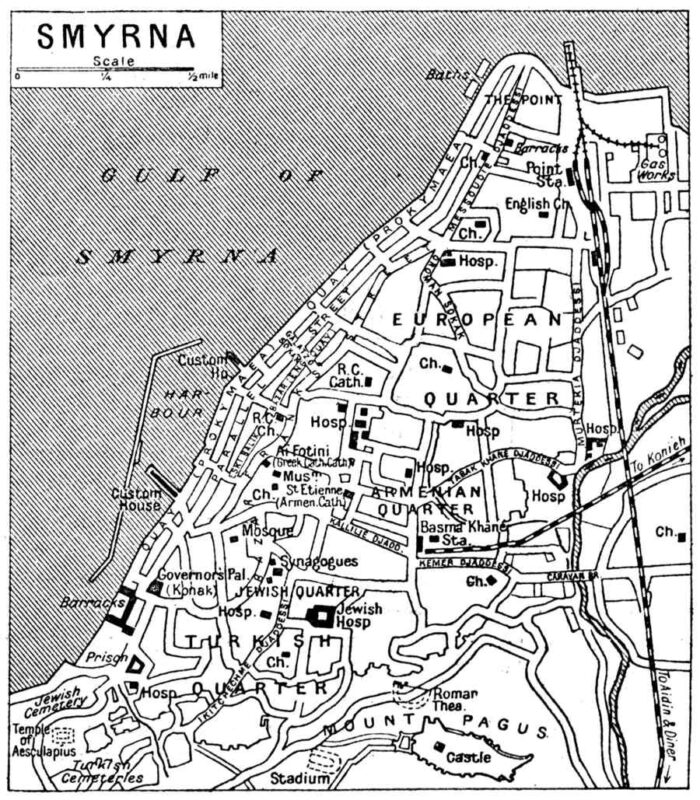
Smyrna before the fire. The blaze began in the Armenian quarter on September 13, 1922, and spread through the Armenian and European quarters; the Turkish and Jewish quarters were largely spared.
Suffering defeat after defeat, the Greek army withdrew from Smyrna in the late summer of 1922. On September 9, the Kemalist army entered the city to reassert control and remove the lingering Greek presence. As the Greek army’s presence waned, the remaining Greek and Armenian inhabitants were increasingly targeted by the Turkish army.
On September 13, fires set by Turkish forces broke out in the Armenian quarter. The Great Fire of Smyrna, as it would later be known, spread quickly through the city. The chaos and panic that followed is difficult to imagine. The devastation was captured in firsthand accounts by relief workers and in photographs that remain hard to look at.
A view of Smyrna burning from across the harbor, September 1922. Image courtesy of the Armenian Genocide Memorial-Institute.
Tens of thousands of Greeks and Armenians fled to the coast. Warships from a dozen nations sat in the harbor, but American forces — under Admiral Mark Bristol, the U.S. High Commissioner in Turkey — and their British, French, and Italian counterparts operated under orders that largely confined them to evacuating their own nationals. Near East Relief was called into action once again.
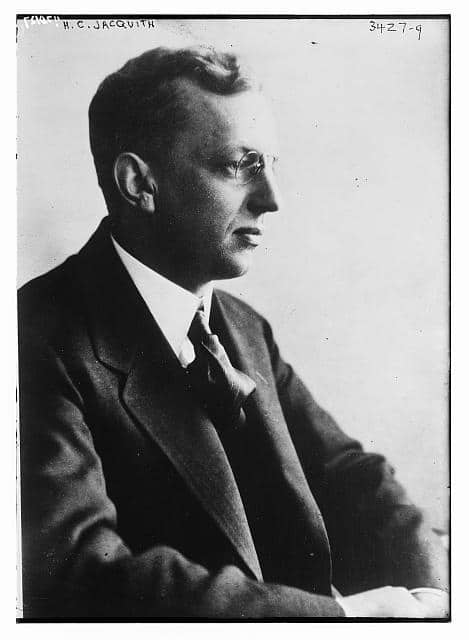
Harold C. Jaquith, Managing Director of Near East Relief in Constantinople. Library of Congress, Bain News Service.
The day of the fire, Harold C. Jaquith, Managing Director of Near East Relief in Constantinople, sailed to Smyrna with a ship of emergency supplies. NER’s existing supplies in the city had been destroyed in the fire that consumed two-thirds of Smyrna, and evacuation was the only solution. NER orphanages in Constantinople sent flour, rice, beans, and milk to feed the survivors. In the United States, NER’s emergency fund was being used to gather additional supplies for Smyrna and to replenish what was being drawn down in Constantinople.
Refugees on the Smyrna quay with an American naval launch in the foreground, September 1922.
While supplies were gradually restocked, Smyrna also faced unsanitary conditions that bred widespread outbreaks of cholera and smallpox. The city water had been cut off, and deportations to Greece and further into Turkey continued. Refugees waiting to be evacuated died of exhaustion, lost their reason, took their own lives, or refused to move further inland for fear of additional Turkish persecution.
Amidst the chaos, Dr. Esther Pohl Lovejoy of the American Women’s Hospitals delivered infant after infant on the railroad pier at Smyrna. The survivors became entirely dependent on the American relief workers who were rationing the available bread and water after it was restored. Jaquith ensured the aid reached every refugee, regardless of religious or ethnic background.
A Near East Relief fundraising appeal for Smyrna, late 1922. Donors were asked to mark contributions "Smyrna" and send them to NER headquarters at 151 Fifth Avenue, New York.
To meet the demands of the refugee influx, Jaquith and other NER leaders turned again to the strategy of citizen philanthropy that had carried Near East Relief through earlier crises, asking the American public to give what they could.
Back in Constantinople, the Greek Orthodox community ordered an inventory of church treasures, hoping to raise funds to support their refugees. Those who had been deported from Smyrna wandered the shores subsisting on what little food was available, while relief workers worked tirelessly to direct medical supplies to the sickest among them.
While Greek relief workers aided those in Constantinople, the Americans pushed to evacuate refugees to Syria before the deadline imposed by the Turkish government.
By October 1, all refugees had to be gone.
Orphans line up with small bundles of belongings along a Constantinople pier, awaiting transport to Greece in the aftermath of the Smyrna catastrophe, late 1922.
Working around the clock, NER relief workers evacuated as many people as they could and found themselves caring for even more children, in more desperate circumstances, than were already in NER orphanages across the Near East.
The number of refugees saved is only an approximation. An estimated 200,000 refugees were ultimately transported from Smyrna to Greece on Greek military ships secured for the evacuation by Asa Jennings, a YMCA worker from upstate New York, and Lt. Commander Halsey Powell of the U.S. Navy.
Between 50,000 and 100,000 Greek and Armenian people died as a result of the fires and accompanying massacres.
How many thousands were saved, and the stories of those who lost their lives, may never be fully known. What is clear is that, despite the risks and political uncertainty, NER workers responded to the catastrophe they faced and continued building orphanages to shelter, educate, and care for survivors. Their work remains one of the era’s clearest demonstrations of humanitarian commitment in the face of unimaginable tragedy.
Refugees travel by donkey in the wake of the Smyrna catastrophe. Tens of thousands were relocated overland in the weeks and months that followed.
In 2015, journalist Lou Ureneck published The Great Fire (later reissued as Smyrna, September 1922), the most thorough English-language account of the catastrophe and the improvised American rescue at its center. Jennings’s role coordinating the evacuation had largely fallen out of the historical record before Ureneck’s archival reconstruction.