Between September 1915 and 1930, one American humanitarian organization operated under five successive names. The staff and trustees carried over from one to the next. The mission held: response to the Armenian, Greek, and Assyrian Genocides and their long aftermath. The letterhead did not. It began as the American Committee for Armenian Relief, became the American Committee for Armenian and Syrian Relief, then the American Committee for Relief in the Near East, then Near East Relief, and in 1930, the Near East Foundation. A researcher pulling files at the Rockefeller Archive Center can encounter all five names in a single afternoon and plausibly conclude that the boxes have been mixed. They have not. Each name marks a moment of expansion in the work and a clue to the date of any document that carries it.
Dispatches
What’s in a Name? Near East Relief from Committee to Foundation
Many Names, One Mission
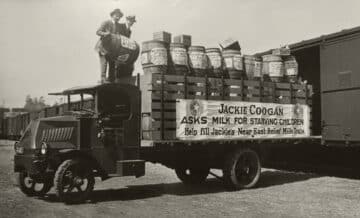
The five names appear in sequence in the surviving record. The American Committee for Armenian Relief was formed in New York in September 1915 within weeks of the first reports of mass deportations from Anatolia. That fall it absorbed parallel Syrian and Lebanese relief efforts and renamed itself the American Committee for Armenian and Syrian Relief. By 1918 the work had expanded across Greece, Persia, and the Caucasus, and the committee took a name to match: the American Committee for Relief in the Near East. The fundraising posters most Americans associate with the campaign, including the “Lest They Perish” appeals of the $30,000,000 drive, were issued under that name.
The records of the organization sit across many institutions. Correspondence between the American Committee for Armenian Relief and American newspapers, including eyewitness accounts of the genocide smuggled out of Ottoman Turkey, is held in the papers of board members and missionary networks. Fundraising pamphlets issued under the American Committee for Armenian and Syrian Relief turn up in the records of churches and women’s auxiliaries that ran the campaign at the local level.
Photographs stamped “Near East Relief” on the back appear in NER worker collections at Rutgers, the Hoover Institution, and Goshen College.
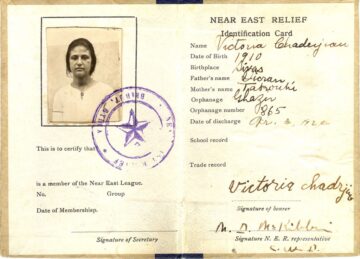
The Rockefeller Archive Center holds the principal institutional archive across all five names — the predecessor committee records from 1915, the Near East Relief papers from 1919, and the Near East Foundation records from 1930 forward — gathered under the Near East Foundation Records (FA 406) when NEF transferred the collection in 2011.
An Expanding Scope of Work
All five names refer to the same entity. In 1927, three years before the institution would change its name yet again, Near East Relief’s Board of Directors took stock of the previous twelve years. The Annual Report to Congress accounted for the names directly:
“Near East Relief has done its work during the past 12 years under four different names:
- The American Committee for Armenian Relief, September 16, 1915, to November 20, 1915.
- The American Committee for Armenian and Syrian Relief, November 20, 1915, to June 27, 1918.
- The American Committee for Relief in the Near East, June 27, 1918, to August 6, 1919.
- Near East Relief, the name by which it was incorporated by Congress, since August 6, 1919.”
These four names reflect the steadily expanding scope of Near East Relief’s work and the transition from the emergency service of the first committee to the well-developed educational and reconstruction program of the present corporate organization.
Near East Relief in Transition
The name changes create confusion in the archive. They also offer something useful: the name on an undated document gives a rough date range. By the mid-1920s, NER’s Board could see that the work itself was about to change again.
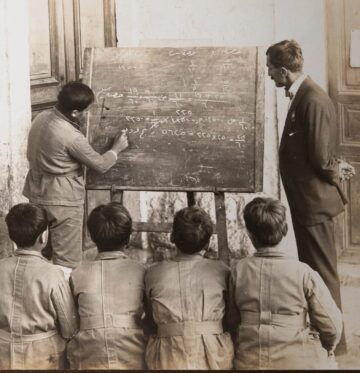
In 1925, the Near East Relief Board appointed a Survey Commission to assess ongoing needs in the region. The orphans who had been small children at the organization’s founding were now young adults seeking livelihoods. The program turned toward practical education that could prepare them for working lives.
The Commission saw a larger pivot coming. The future would bring big changes to the region and to the organization, and the transition from relief to development was overdue.
Greek Macedonia became Near East Relief’s working laboratory. By 1929, approximately nine thousand former Near East Relief orphans had been “out-placed” to farming communities in rural Macedonia. Using that population as a nucleus, Near East Relief built a rural education program that grew to serve newer refugees and the long-settled communities around them.
The Near East Foundation Is Born
In 1930, a fifth name joined the list: the Near East Foundation (NEF). The new name signaled a new mandate. The Foundation’s programs would aim to promote long-term rural development and build models that other governments and agencies could adapt.
The Near East Relief staff carried the work into the new organization. Barclay Acheson, James L. Barton, and Alice Carr were among them. Laird Archer ran NEF’s Athens office, expanded Macedonia’s village school program through the 1930s, and in 1944–1945 served as Chief of the UNRRA Mission to Greece. Harold B. Allen, NEF’s Educational Director, surveyed Iran in 1943–1944 and Ghana in 1956. Lyle Hayden opened NEF’s Iran program in 1946 in five villages of the Varamin plain.
The model traveled. On May 25, 1949, the Iranian Ambassador formally asked the United States to design Point Four in Iran “on the Near East Foundation pattern.” A year later, addressing the American Newspaper Guild in Washington, President Truman named NEF’s Iran program as the program that Point Four would replicate.
President Harry S. Truman, Address before the Annual Convention of the American Newspaper Guild, Washington, D.C., June 28, 1950 (excerpt, 8:36–10:00). Public Papers of the Presidents: Harry S. Truman, 1950. Audio: G. Robert Vincent Voice Library, MSU Libraries, Voice 6335.
Point Four became USAID in 1961. Pauline Birky-Kreutzer, who served with NEF in Iran from 1956 to 1958, joined Maurice Albertson’s Colorado State University team and co-authored the May 1961 Congressional feasibility study that recommended the creation of the Peace Corps — and named NEF among the precedents proving that federally funded private agencies could operate effectively overseas. Under John S. Badeau’s NEF presidency (1953–1961), the Foundation entered Africa and conducted a community development program in South Korea.
The institutions that emerged from that work are still operating. The American University of Beirut’s Faculty of Agricultural and Food Sciences ran its upper Beka’a Valley extension program in partnership with NEF and the Lebanese Ministry of Agriculture. The Ahwaz Faculty of Agriculture, now the Agricultural Sciences and Natural Resources University of Khuzestan, operated under NEF management from 1960 to 1968 through a contract with the Iranian Ministry of Education, during which NEF wrote the curriculum, built laboratories, dormitories, and demonstration farms, and recruited faculty. Urmia University’s four-year Faculty of Agriculture exists in its current form because of a 1969 NEF–Iranian Ministry of Culture agreement under which NEF wrote the curriculum. The American University in Cairo’s Desert Development Center, now the Research Institute for a Sustainable Environment, ran on NEF grant support through the 1980s and 1990s.