
1930
Armenian Distress and Christian Aid
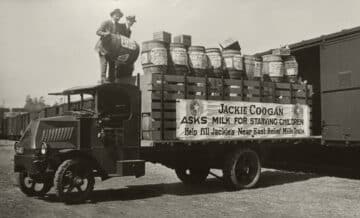
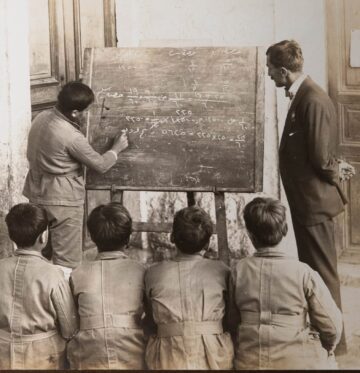
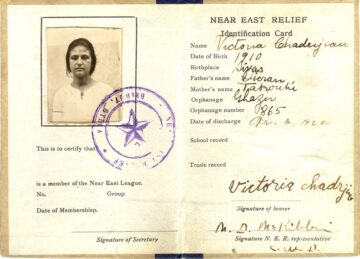
Naturfilm Hubert Schonger made Armeniernot und Christenhilfe (Armenian Distress and Christian Aid) in 1930 for the Deutsche Orient-Mission, the society Johannes Lepsius founded. The film draws on footage shot at different times in the 1920s: the caravans to Syria, the orphanages of Greece, Jerusalem, Nazareth and Ghazir, and the refugee camps of Beirut and Aleppo.
1930
The Film in Thirteen Scenes
The film is shown here in thirteen scenes, divided at its own title cards. English translations of the German cards appear beside each scene. The complete film follows at the end of the page.
Part 1
Deportation, Rescue and Refuge
Bundesarchiv, Armeniernot und Christenhilfe, Film: 54842.
Scene 1 · 2:27
Deportation and rescue to Syria
“During 1915 and 1916, 1.5 million Armenian Christians, most of them old people, women and children, were driven into the Arabian deserts.”
“Here, during the World War, hundreds of thousands perished.”
“Thousands of children were taken from endangered areas to safe Syria (8,000 children by the missionary Jakob Künzler alone).”
In this scene, camels carry loads marked American Near East Relief.
Bundesarchiv, Armeniernot und Christenhilfe, Film: 54842.
Scene 2 · 2:40
Syria: the mission gates and the refugee colonies
“How many of the survivors could be saved from certain death was the great question.”
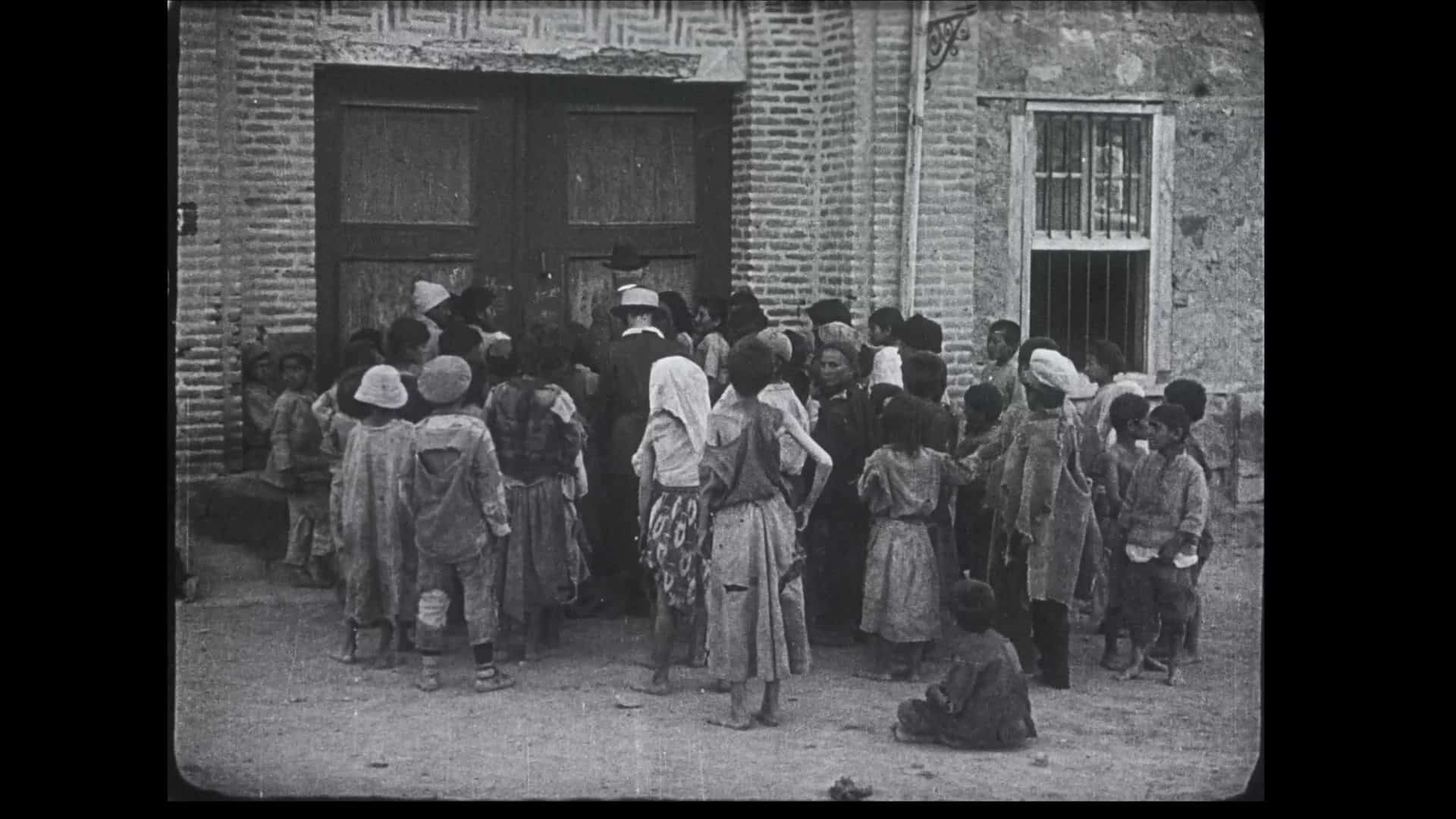
“The children were the first to gather at the gates of the mission houses. They were clothed and fed, and adults able to work were given building timber.”
“In this way whole colonies of rescued refugees grew up in Syria.”
Bundesarchiv, Armeniernot und Christenhilfe, Film: 54842.
Scene 3 · 2:37
Greece: Athens and Syra (Syros)
“22,000 orphans were rescued to Greece and supported by the American relief organization. They found refuge at the foot of the Acropolis and on the island of Syra.”
“The Greek government donated land and building materials on Syra, and the boys built their own orphanage, with a garden and classrooms.”
“Assembly of the orphans in the open air.”
“The whole crowd of thousands must be fed every day, both those on Syra and the 18,000 in Alexandropol (Armenia).”
“The American relief organization” is Near East Relief.
Part 2
Orphanages in Palestine and Lebanon
Bundesarchiv, Armeniernot und Christenhilfe, Film: 54842.
Scene 4 · 1:25
Jerusalem and Nazareth
“Armenian orphanages were also founded in the Holy Land. (1. Jerusalem)”
“Many of the Armenian girls were freed from Mohammedan harems by the mission.”
“In the orphanage at Nazareth. The mission trains the boys to be skilled craftsmen.”
Bundesarchiv, Armeniernot und Christenhilfe, Film: 54842.
Scene 5 · 2:58
Ghazir: the girls’ orphanage
“At Ghazir in Lebanon is the girls’ orphanage of Dr. Lepsius’s German Orient Mission. Children who have outgrown school learn weaving and carpet knotting here.”
“Eye treatment in the orphanage.”
“In the courtyard of the orphanage at Ghazir. A bath in the water basin.”
Bundesarchiv, Armeniernot und Christenhilfe, Film: 54842.
Scene 6 · 1:27
Ghazir: past the camp, and the workshops
“After the day’s work, a walk together leads past the camp where they once languished. Many who envy them are still there.”
“Crafts in the orphanage.”
Bundesarchiv, Armeniernot und Christenhilfe, Film: 54842.
Scene 7 · 0:56
Christmas from Potsdam
“The Christmas crate from Potsdam, the seat of the mission, is received by Künzler, the orphans’ ‘father,’ and his daughter Marie hands out the gifts to the children.”
Bundesarchiv, Armeniernot und Christenhilfe, Film: 54842.
Scene 8 · 0:48
Beirut: the camp from above
“Beirut, with the Armenian refugee camp.”
Part 3
The Camps at Beirut and Aleppo
Bundesarchiv, Armeniernot und Christenhilfe, Film: 54842.
Scene 9 · 1:53
Beirut: shacks of crate wood and tin
“Christian charity has snatched many people from death, but tens of thousands are still fighting a terrible struggle to survive.”
“The refugee camp at Beirut, on the eastern shore of the Mediterranean, looks picturesque from a distance. In reality it holds crying misery.”
“Shacks of crate wood and sheet tin house 12,000 refugees. Laundry flapping in the wind everywhere shows a strong sense of cleanliness.”
Bundesarchiv, Armeniernot und Christenhilfe, Film: 54842.
Scene 10 · 2:20
Beirut: 1,500 barracks
“On barely one square kilometer, 1,500 barracks have been built for more than 20,000 people.”
“This is what the huts look like inside.”
“For the many young people in the narrow lanes between the barracks, the danger of neglect is great. Even the youngest in the cradle is the parents’ worry and hope.”
“In the street we see a baker, a barber and a coppersmith at work. The woman gluing paper bags was once well-to-do. The streets are disinfected.”
Bundesarchiv, Armeniernot und Christenhilfe, Film: 54842.
Scene 11 · 2:08
Aleppo: the widows’ colony
“There is a refugee camp like this in Aleppo too. Dr. Lepsius’s German Orient Mission has built small houses there for widows and orphans: the widows’ colony.”
Bundesarchiv, Armeniernot und Christenhilfe, Film: 54842.
Scene 12 · 1:00
Aleppo: Miss Jeppe’s colony
“With the mission’s help, Miss Jeppe set up a small colony in which each widow has a room. Childless widows are given orphans to bring up in the Christian faith.”
“They earn their living by fine needlework. In this way family feeling and national character are preserved.”
Miss Jeppe was Karen Jeppe, a Danish relief worker in Aleppo.
Bundesarchiv, Armeniernot und Christenhilfe, Film: 54842.
Scene 13 · 1:45
Outside and inside
“The difference! ‘Outside – Inside.’”
“Little birds that have found a nest.”
“Those who could be saved are cared for, but what happens to those still outside? They are still holding out their hands to us.”
“‘Break your bread for the hungry, and bring into your house those who are in misery. When you see the naked, clothe him, and do not turn away from your own flesh.’ Isaiah 58:7.”
The “little birds” passage also plays on its own in chapter 7 of On Film.
The Complete Film
Armeniernot und Christenhilfe, 1930, in three parts, 24 minutes, silent with German title cards. Naturfilm Hubert Schonger for the Deutsche Orient-Mission.
Bundesarchiv, Armeniernot und Christenhilfe, Film: 54842. English translations by the Near East Relief Historical Society. The film can also be viewed in the Bundesarchiv digital reading room.