
Collections
Posters and Banners
Before Americans gave, they were made to see. Beginning in 1917, the relief committee commissioned the country’s leading illustrators to put the emergency on walls, in streetcars, and in shop windows: Douglas Volk’s “They Shall Not Perish,” painted for the 1919 Campaign for $30,000,000, and Ethel Franklin Betts’s “Lest We Perish,” whose pleading child became one of the most reproduced American images of its era. Three years after a founding meeting that raised $60,000, the organization was asking the public for $30 million — and the posters were how it did so.
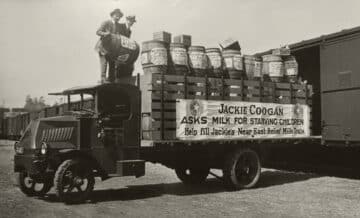
This collection presents original campaign materials from Near East Relief’s publicity operation: illustrated posters, painted banners, cablegrams from the field that were released to the press, newspaper advertisements, and promotional materials for national observances such as Bundle Day and Near East Relief Day. The originals are held at the Rockefeller Archive Center within the Near East Foundation records, and the collection continues to grow as digitized holdings are processed and cataloged.
Near East Relief was among the first organizations to apply modern mass advertising to humanitarian relief. The posters raised millions and fixed the emergency in the American imagination, and the conventions invented here — the child’s direct gaze, the arithmetic of lives per dollar — remain the standard grammar of humanitarian appeals a century later.