1915–1919
Relief Begins
Though Near East Relief’s phenomenal fundraising efforts provided sorely needed supplies, survivors of the Genocide also required hands-on aid, including medical care. Near East Relief funded the efforts of missionaries who bravely remained in the region despite turmoil. In 1919, Near East Relief began sending its own workers to bolster the relief effort.
1916
One Million Survivors
Ambassador Morgenthau estimated that one million Armenian refugees had survived the Genocide. The survivors were mainly women and children left destitute by the deportations. By the end of 1916, the Committee was assisting as many as 500,000 women and children. Hundreds of people in Constantinople were dying of starvation, having nothing to eat but grass.
1915 – 1918
Rescue
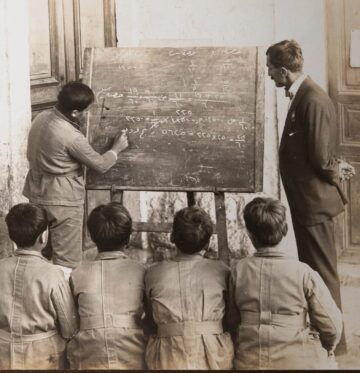
The deportations of Armenian Christians left the once-thriving mission stations in Armenian communities empty. Missionaries used Committee funds to convert existing mission buildings into relief centers and orphanages. The relief stations quickly filled with children – many of them the sons and daughters of former students.
The children that were gathered from the roadside or left upon the doorstep formed the first nucleus of the future orphanages of Armenian and Greek children.
1915 – 1922
An Unofficial Diplomat
Annie T. Allen was born to pioneering missionaries in Harput, Turkey, in 1868. After graduating from Mount Holyoke College in 1890, she began her own mission work in Brousa, Turkey, in 1903. Her fluency in several languages allowed her to establish a connection with the refugees she served, and to communicate with local political leaders.
In 1921, Miss Allen transferred from Brousa to Konia, a refugee center and orphanage in the war-torn Turkish interior. She traveled the surrounding areas and drafted reports on the dire living conditions she witnessed. Miss Allen also visited Near East Relief stations to document the organization’s accomplishments and challenges.
During the bitter winter of 1922, Miss Allen set out for Harpout on horseback to investigate the conditions among Armenian and Greek deportees as they were being forced to march through the interior. When she was injured in a fall from a carriage during her travels, her doctors discovered she was also seriously ill with typhus. Annie T. Allen died in Sivas on February 2, 1922, and was buried with full Turkish military honors.
Miss Annie T. Allen
Refugee Hospitals
American medical professionals had worked in Asia Minor for years. Dr. Ruth Parmelee worked at the American hospital at Harput. She would become a Near East Relief volunteer through the American Women’s Hospitals organization. Similar hospitals staffed by American and Armenian doctors and nurses existed throughout the Anatolian Peninsula.
Near East Relief (then known as The American Committee for Armenian and Syrian Relief) had 38 local committees in 16 states by June 1916.
October 21-22, 1916
“Remember the Starving Armenians”
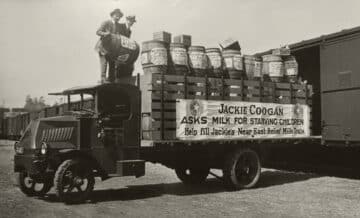
President Wilson declared these “joint days for Americans to make contributions for the Armenians and Syrians.” Churches, synagogues, and service organizations like the Rotary and Lions clubs raised donations. Parents told children to “remember the starving Armenians” and not to waste food at mealtimes.
President Wilson appealed to the American people to donate for Armenian and Syrian relief.
Receipts in reality are considerably in excess of $10,000 per day. This does not include any of the large checks which we know to be coming.
1917 – 1919
April 6, 1917
The U.S. declares war on Germany and enters World War I on the side of the Allied Powers.
The Ottoman Empire broke diplomatic ties with the U.S. Diplomatic representatives returned to the U.S., but many American missionaries remained at their posts. The U.S. never formally declared war against the Ottoman Empire.
By June 1918, $10,500,000 had flowed in from 24 countries to 67 relief stations.
Winter 1919
Assessing Need: The Caucasus Mission
A special Commission made up of civilian volunteers and U.S. military officers sailed to the Near East to assess the refugee situation. The commissioners concluded that 50,000 – 60,000 children were then in care and that Near East Relief should prepare to care for 120,000 children by the end of 1920.
February 1919
4,000 Tons of Supplies
Near East Relief launched the steamship Pensacola for Beirut, Syria (present-day Lebanon), carrying 4,000 tons of food and supplies. On February 19, 1919, 250 Near East Relief volunteers sailed from Hoboken, NJ, on the S.S. Leviathan. The party included doctors, nurses, and other technical specialists.
August 1919
Near East Relief Chartered
Having grown beyond the resources of a small volunteer committee, Near East Relief was chartered as a charitable corporation by an Act of Congress.