
1930–onward
The Legacy of Near East Relief
In 1930, Near East Relief adopted the name Near East Foundation (NEF) to express its new focus on sustainable development. NEF’s early projects in Greek Macedonia, Lebanon, and Iran became models for other international programs, including the United States Agency for International Development (USAID) and the Peace Corps. NEF continues to promote knowledge, voice, and enterprise in the Middle East and North Africa.
1925–1930
From Near East Relief to Near East Foundation
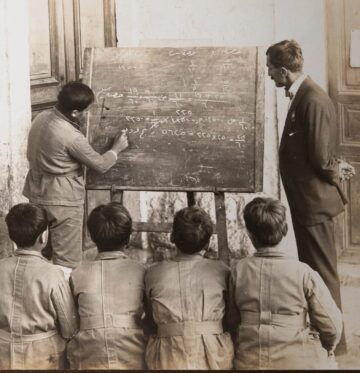
The Board appointed a Survey Commission to identify locations in need of continued assistance. The orphans that were small children when Near East Relief began its work were now young adults seeking a livelihood. Upon the Survey Commission’s recommendation, Near East Relief began to focus on practical education in an effort to create sustainable societies.
Greek Macedonia was a natural laboratory for Near East Relief’s transitional projects. Nearly two thirds of the 1.1 million ethnic Greeks that had left Asia Minor had settled in Macedonia. By 1929, approximately 9,000 former Near East Relief orphans had been “out-placed” to farming communities in rural Greek Macedonia. Using the former orphan population as a nucleus, Near East Relief implemented a rural education program that grew to include refugees and native populations.
Sophie Kyriakou was a Near East Relief orphan who became a Near East Foundation instructor in Greek Macedonia.
“Imagine My Happiness”: Sophie Kyriakou’s Story
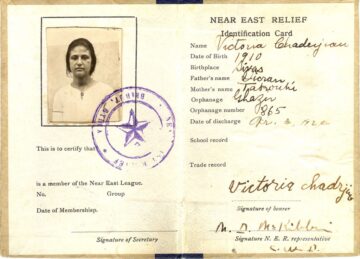
Sophie Kyriakou was only four years old when her father was killed and her mother died. Young Sophie found herself in a Near East Relief orphanage in Athens, where she devoted herself to learning. Sophie graduated from the Home Economics School in Athens and joined the Near East Foundation in Greek Macedonia as a home economics instructor.
Sophie taught basic skills like cooking and sewing. She also educated women and girls about sanitation in the home as a way to avoid illness. Sophie was working in Greek Macedonia when the Italian army invaded Greece in 1940, sparking Greece’s involvement in World War II. Greece suffered heavy damage under Axis occupation.
The Near East Foundation organized centers called “Eagle’s Nests” to care for children from 1,700 destroyed villages. The Eagle’s Nests provided food, clothing, medical care, and education. Sophie Kyriakou found her calling as the director of the Eagle’s Nest at Agrinion, where she supervised 200 children.
Imagine my happiness, I, who had been a homeless and helpless orphan, now a grown woman, helping children who were going through the same heartbreaking trials which I had experienced as a child! My joy knows no bounds!
The Armenian Diaspora
Some refugee settlements developed into permanent communities, while other Armenian refugees immigrated to other countries. This gave rise to a thriving Armenian diaspora. Thousands of Armenians settled in Syria, particularly in the urban areas of Beirut and Aleppo. Many Armenians remained in Greece, where they assimilated with the local community while maintaining their Armenian Apostolic faith.
Tens of thousands of Armenian refugees emigrated from areas of French-controlled Syria to France, settling mainly in Paris and Marseille. France has the largest Armenian community in Western Europe (and the largest in the European Union).
Armenia
Armenia was Sovietized in 1920 and joined the Transcaucasian Soviet republic in 1922. It declared sovereignty in 1990 and voted for independence by referendum on September 21, 1991, with the result confirmed by parliament two days later. Levon Ter-Petrosyan was elected Armenia’s first president in October 1991. The Soviet Union was formally dissolved that December.
Armenians in America
Thousands of Armenians immigrated to the United States to join family members in Los Angeles and New York City. Thriving Armenian communities developed in Massachusetts and Illinois. War and economic instability in the Middle East and the collapse of the Soviet Union prompted a new wave of Armenian immigration to the United States and France in the 1990s.
This map of the modern Republic of Turkey features a soldier and a woman draped in the Turkish flag, watched over by Kemal Pasha Atatürk.
The Republic of Turkey
Under the Treaty of Lausanne (July 24, 1923), the Allied powers recognized the new Turkish state and its borders, superseding the Treaty of Sèvres. The Republic of Turkey was proclaimed on October 29, 1923. A related convention forced a population exchange of approximately 1.2 million Greek Orthodox Christians and about 355,000–400,000 Muslims.
Mustafa Kemal Atatürk served as president until his death in 1938. To date, Turkey has not acknowledged the events of 1915–1922 as genocide.
A Model for International Development
The Near East Foundation trained village leaders and worked through them to improve farming, health, and education. This showed that outside help could build lasting local capacity rather than dependence. Tested first in Greek Macedonia and then in Iran, the approach became a template for the aid programs that followed the Second World War, and Foundation staff helped run the new international agencies directly: Laird Archer, its longtime overseas director, served as the first head of the United Nations Relief and Rehabilitation Administration’s mission in Greece.
In 1950 President Harry Truman held up the Foundation’s work in Iran as the model for Point Four, the first American program to make technical assistance to poorer nations a permanent goal of foreign policy. He described the thirty-five villages near Tehran where the Foundation had helped triple the grain harvest, and predicted that the story would “be matched many times over.” The same methods carried forward into the U.S. Agency for International Development and the Peace Corps. The feasibility study that launched the Peace Corps was co-written by Pauline Birky, who had done community-development work in the Foundation’s Iranian villages.
Listen: President Harry S. Truman, Address before the American Newspaper Guild, Washington, D.C., June 28, 1950 (excerpt, 8:36–10:00). Audio: G. Robert Vincent Voice Library, MSU Libraries, Voice 6335.
100 Years of Relief and Development
“Those who dwell in the Near East have been impressed, through the work of this Committee, with what they regard as the true spirit of our people. They can see embodied in the fifteen years of disinterested operations, the sincere desire and purpose to render help to peoples in extreme need . . . and consciousness of having responded to a call to duty.”