
1918–1922
The Burning of Smyrna
Despite the end of World War I and the constant efforts of Near East Relief, the violent persecution of Christian minorities in the Near East continued. Peace remained elusive, and Near East Relief workers found themselves caught between shifting world forces. The destruction of the ancient city of Smyrna marked a turning point for Near East Relief. The catastrophe reignited violence throughout the Anatolian Peninsula. Near East Relief workers were forced to make sudden, life-saving decisions.
1918
October 30, 1918
World War I Ends
Finally admitting defeat, the Ottoman government signed the Armistice of Mudros. The empire had finally collapsed. The Allied Powers, including the United States, began carving up the Empire’s remains and installed a temporary government in Constantinople favorable to their goals.
January 18, 1919
The Paris Peace Conference
Against this turbulent backdrop, representatives from 27 countries convened in Paris to discuss the terms of peace for the defeated Central Powers. Britain, Italy, France, Greece, and Russia all laid claim to portions of the collapsing Ottoman Empire. President Wilson advocated for a League of Nations to govern emerging countries through a mandate system and campaigned for the establishment of Armenia as an American mandate.
May–June 1919
Partitioning Begins
The Allies gave the Greek army permission to occupy the historically Greek city of Smyrna on the west coast of the Anatolian Peninsula. The Greek army landed in May, to celebration among ethnic Greeks and anger among ethnic Turks. Greece and Ottoman Turkey were soon embroiled in war.
June 28, 1919
The Treaty of Versailles
The Treaty of Versailles formally ended hostilities between Germany and the Allies and created the League of Nations. Although President Wilson was an ardent supporter, the increasingly isolationist United States government chose not to join. The Greek army remained in Smyrna and the surrounding area after the Treaty was signed.
Armenia is to be redeemed, so that at last this great people, struggling through night after night of terror…are now given a promise of safety, a promise of justice…
1919
June 1919
The Rise of Turkish Nationalism
The conflict in Smyrna helped fuel the rise of Mustafa Kemal Pasha and Turkish nationalism. A former Ottoman military officer (later known as “Atatürk,” or “Father of the Turks”), Kemal broke with the Allies-approved Ottoman government and declared an independent Turkish state. He assembled a competing government, the Turkish Grand National Assembly, and waged the Turkish War of Independence.
“It is absolutely necessary that Armenia be politically and physically eliminated.”
1920 – 1922
January 1920
Survivors in Peril
Mustafa Kemal Pasha’s “Turkey for Turks” program recalled the genocidal plans of the Young Turk government. Turkish Nationalist forces marched on Marash, an important center of Near East Relief activities in central Anatolia. Dr. Mabel Elliott, a Near East Relief physician on loan from American Women’s Hospitals, fled the city on foot with 5,000 refugees. Nearly half died of exposure on the three-day trek to safety.
Later in 1920, Dr. Elliott returned to Ismid, Turkey, where she created a modern hospital with nurse’s training classes, a clinic, and a soup kitchen.
The Proposed Treaty of Sèvres
The Allies proposed the Treaty of Sèvres, which parceled Ottoman territories among the Allied powers and called for Turkey to recognize Armenia as an independent state, with boundaries set by the U.S. President. The Ottoman Grand Vizier signed the Treaty, but it was never ratified and only inflamed Turkish nationalism.
Invasion
The Turkish Nationalist army invaded the nascent Republic of Armenia. At the Near East Relief complex in Alexandropol, 20,000 children were cut off from supplies until the first relief shipment reached them from Batoum in April 1921. Soviet rule was proclaimed in Armenia in late November–December 1920. Alexandropol itself remained under Turkish occupation until the Treaty of Kars (October 1921).
1921
The Trek to Safety
France withdrew its troops from Cilicia, which it had occupied in anticipation of the Treaty of Sèvres. The region was left vulnerable to the Turkish Nationalist army, and Near East Relief began the arduous process of moving 12,000 children out of central Anatolia to safety in Syria.
September 1922
The Great Fire
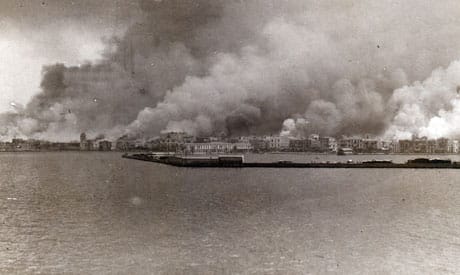
After repeated defeats by the Turkish Nationalist army in Anatolia, the Greek army withdrew from Smyrna. Turkish Nationalist forces entered the city on September 9, 1922. Four days later, fires raged through its Christian quarters. Most historians conclude the fire was set by Turkish forces.
Greek and Armenian homes were looted. An estimated 300,000 Greek and Armenian people fled to the docks to escape the burning city. Three U.S. ships in the harbor declined to intervene, citing U.S. policy against American involvement in the conflict.
An estimated 200,000 refugees were ultimately carried from Smyrna to Greece on Greek military ships. Between 50,000 and 100,000 Greek and Armenian people died as a result of the fires and accompanying massacres.
Relief After Smyrna
The fire destroyed an ancient multicultural community. It also marked the ascent of the Turkish Nationalist government. Near East Relief workers realized that neither they nor their charges were safe in Nationalist-controlled Turkey and organized a mass evacuation of orphans and refugees to safer territory.