
1914–1915
The Genocide
By 1914, civil rights for Ottoman Armenians finally seemed within reach. At the same time, the world was descending into an unprecedented war. The Ottoman Armenians’ quest for equality would soon collide with emerging global conflicts – with horrific consequences.
1914
February 8, 1914
An Opening for Equality?
The Ottoman Empire had lost almost all of its European territory in the Balkan Wars of 1912–1913. Russia remained a formidable enemy. Recognizing that the Ottoman Empire was newly vulnerable, a group of Armenian activists approached the European powers and Russia about a reform program.
Officials from the Russian and Ottoman Empires signed the Armenian Reform Act on February 8, 1914. The Act created two provinces from six historically Armenian vilayets in eastern Turkey. It appointed two European inspectors general to oversee Armenian issues; they would live in the vilayets of Erzurum and Van.
December 1914
Quashing Reform
The Reform Act brought international attention to issues that the Ottoman government perceived as internal. The Committee of Union and Progress (CUP) was incensed. The European inspectors had barely reached their posts when an imperial edict sent them home. Under the leadership of Mehmed Talaat Pasha, the Ottoman government suspended the Reform Act in December 1914 based on the Empire’s entry into World War I.
Don’t the Armenians realize the reforms depend on us; we shall not respond to the proposals the inspectors may put forward … Let the Armenians wait, opportunity will certainly come our way too.
Turkey belongs only to the Turks.
June 28, 1914
World War I Begins
Archduke Franz-Ferdinand of Austria, heir to the Austro-Hungarian throne, was assassinated by Yugoslav nationalist Gavrilo Princip in Sarajevo on June 28, 1914. A month later, Austria-Hungary declared war on Serbia. Russia mobilized troops in support of Serbia. The German Empire, Austria-Hungary’s key ally in the Central Powers, invaded Belgium and Luxembourg, and then France. This prompted Britain to enter the war.
The Ottoman Empire Joins the Central Powers
The German Empire was an essential ally in the CUP’s ongoing struggle against the Russian Empire to the east. This alliance enabled the CUP to strengthen its military forces and enhance its technological capabilities. The Empire hoped to annex land in North Africa, Persia, and the Russian Caucasus.
1915
April 1915
The First Deportations
The CUP blamed the Armenians for the Ottoman army’s disastrous attempt to invade Russia in December 1914. The government accused the Armenians of collaborating with the Russian army to thwart the invasion. Ottoman officials used the failed invasion as a pretext for a plan to destroy the Ottoman Armenian population.
The first deportations took place in the city of Zeitun on April 8, 1915. Men were marched out of town and executed. Women and children were forced from their homes and loaded into railroad cars bound for the desert. The Zeitun deportations served as a training event for the Ottoman killing squads.
June 1915
The Sayfo
In the spring and summer of 1915, Ottoman forces and allied irregulars attacked Assyrian Christian communities in Hakkari, Diarbekir, and Urmia. Tens of thousands were killed and tens of thousands more driven into Persia and the mountains. Assyrians remember these events as the Sayfo, or “sword.”
The Defense of Van
April–May 1915
Stateless and caught between two warring empires, the Armenians were more vulnerable than ever.
The tyrannical Djevdet Bey, the vali (governor) of Van, took advantage of this. In April 1915 he demanded that the vilayet offer up more than 4,000 men for forced labor in Ottoman military battalions – a thinly veiled plan to massacre the city’s able-bodied men. The Armenians refused.
Ottoman soldiers laid siege to the city on April 20, 1915.
Armenian civilians defended the city with improvised weapons and barricades. Secret messengers appealed to the Russian army. Russian forces helped the Armenian civilians to drive the Ottoman troops out of the city in May 1915. The resistance at Van became a new pretext for deportation.
Historians estimate that some 55,000 Armenians were killed in massacres across Van province during this period. Dr. Clarence Ussher, an American physician who witnessed the siege and later worked with Near East Relief, recorded the destruction in his account of the city.
The Fate of Women, Children, and the Elderly
Deprived of able-bodied men, the remaining Armenian women, children, and elderly were removed from their homes and deported. Thousands were sold into slavery. Most were forced into cattle cars on the Baghdad Railway.
In October 1915, more than 30,000 Armenians were deported via railroad to Konia, then southeast to the Der Zor Desert. Those who were not massacred upon arrival died of starvation and disease. Thousands more were driven into forced marches.
April 24, 1915
Attacking the Intelligentsia
Days after the Defense of Van began in Eastern Anatolia, the CUP launched an attack on the Armenian intellectual community in Western Anatolia. On April 24, 1915, soldiers arrested approximately 250 Armenian cultural leaders in Constantinople. The diverse city had enjoyed a thriving intellectual life for centuries. It was home to prominent Armenian writers, artists, musicians, merchants, doctors, and clergymen. The men were imprisoned in military barracks. Some were tortured and killed immediately. Within a few weeks, the military had deported more than 2,300 men from northwestern Turkey. The majority died in prison camps in the desolate Turkish interior.
April 24 has been observed as Armenian Genocide Remembrance Day since 1919.
The Ottoman government argued that the resistance at Van showed that Armenians were loyal to Russia. The government increased its attacks against the Armenians.
1916–1922
The Pontic Greeks
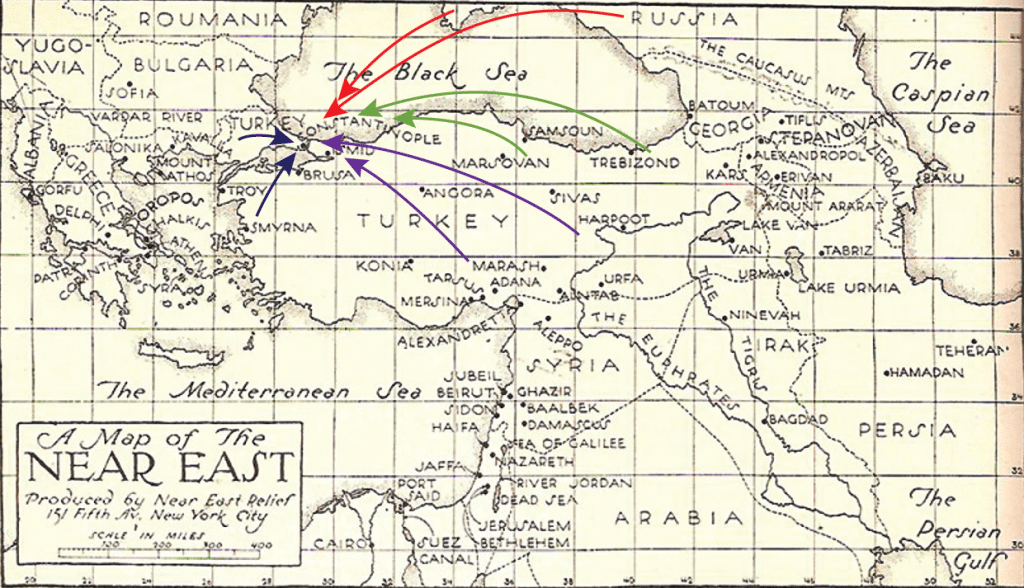
Ottoman authorities deported Greek Orthodox communities from the Black Sea coast and western Anatolia into the interior, where large numbers died of exposure, starvation, and disease. The deportations continued under the Nationalist government after 1919.
Massacres and Death by Forced Labor
When World War I began, Armenian men age twenty and older were conscripted to military service. This was a departure from the pre-1909 policy which prohibited non-Muslims from serving in the Ottoman military – and taxed them for the privilege of exemption. Forced labor battalions produced munitions, clothing, and food for Ottoman soldiers. Many battalions worked on roads and railroads. Though technically members of the military, Armenian laborers were not allowed to carry weapons. Defenseless and despised, many Armenian laborers were massacred in isolated areas.
What is Genocide?
Polish-Jewish lawyer and scholar Raphael Lemkin introduced the term “genocide” in his book Axis Rule in Occupied Europe in 1944. Lemkin defined genocide as “a coordinated plan of different actions aiming at the destruction of essential foundations of the life of national groups, with the aim of annihilating the groups themselves.” Genocide was recognized as a crime under international law in 1948. Article II of the Convention on the Prevention and Punishment of the Crime of Genocide defines genocide as:
“(A)ny of the following acts committed with intent to destroy, in whole or in part, a national, ethnical, racial or religious group, as such: killing members of the group; causing serious bodily or mental harm to members of the group; deliberately inflicting on the group conditions of life calculated to bring about its physical destruction in whole or in part; imposing measures intended to prevent births within the group; [and] forcibly transferring children of the group to another group.”
The International Association of Genocide Scholars has issued three resolutions recognizing the atrocities that took place in the Ottoman Empire from 1914–1923 as genocide.
The most recent resolution, issued in 2007, includes Pontian and Anatolian Greeks and Assyrians as genocide victims.
Genocide can occur in times of war or peace.